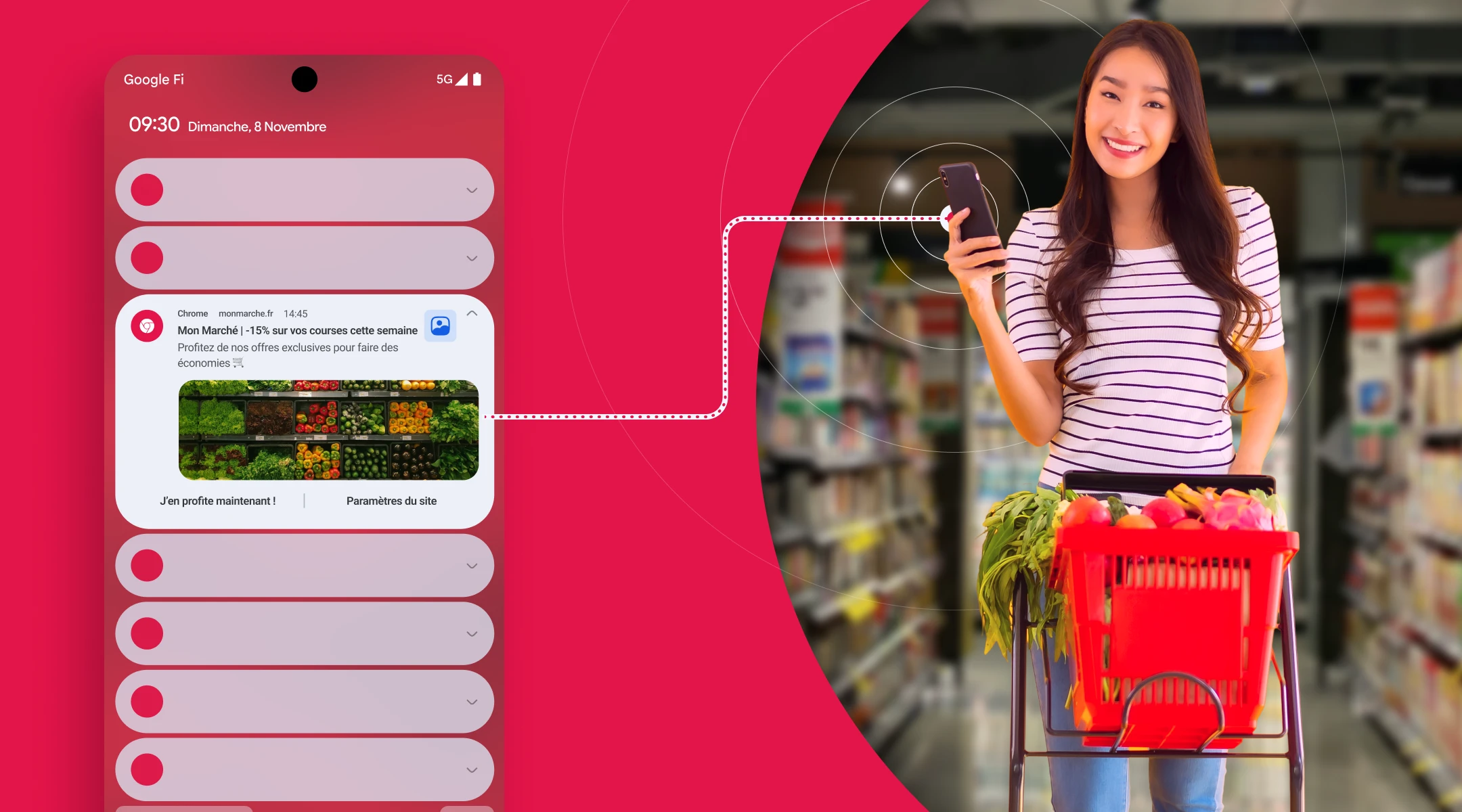
Same campaign, same budget… but different creatives depending on the user being reached. That is the principle of Dynamic Creative Optimization (DCO), which automatically adapts the elements of an advertisement to the profile and context of each internet user.
In 2026, 82% of advertisers have integrated it into their digital advertising strategy according to Digiday and Clinch. The reason is simple: relevant communication converts better and costs less. This marketing strategy is all the more compelling in a context where consumers expect content tailored to their profile. This guide explains how it works, which variables to activate first, and how to apply it today via Web Push.
- What is DCO?
- How it works: three building blocks to master
- The most effective variables
- Sector examples
- DCO & Web Push: the most accessible entry point
- Measured performance
- The 5 mistakes to avoid
- Measuring success
- Best practices for getting started
- Start with Web Push
- Weather, distance, stock, time: every variable transforms an impression into a genuinely useful contact opportunity
What is DCO?
Dynamic Creative Optimization is a real-time personalisation technology. Rather than producing dozens of static creatives, the advertiser designs a single template in which certain zones are variable. These slots fill automatically at each impression, based on available information: local weather, geographic position, real-time stock levels, time of day, CRM profile or browsing behaviour.
The result: from a single advertising creative, thousands of variants are generated. The algorithm’s intelligence produces each element adapted to the internet user. A Londoner caught in the rain receives a message focused on a waterproof jacket available at the nearest store; a Mancunian in 25°C sunshine sees an ad for a cap at their preferred outlet. The creative work remains singular — it is the algorithm that orchestrates the diversity.
| Static | Basic dynamic | DCO | |
| Personalisation | None | Predefined | Real-time, multi-variable |
| Sources activated | None | Product catalogue | Weather, geo, behaviour, stock… |
| Variants | 1 to 10 | Dozens | Unlimited |
| Optimisation | Manual A/B test | Fixed rules | Automatic |
How it works: three building blocks to master
A DCO advertising campaign rests on three complementary components. First, data: contextual (weather, time, device, geographic position), behavioural (browsing history, cart), catalogue (stock, price) and first-party (CRM, audience segment). The fresher and more precise these feeds, the higher the relevance.
Next, delivery rules: the advertiser defines the conditions that trigger a given variation (“if weather = rain AND distance < 5 km, display this product”). The technology then takes over, continuously testing and optimising winning combinations, leveraging human creativity multiplied by the algorithm.
Finally, the creative template: it sets the layout, brand guidelines and typography, while reserving modular zones for content that will change. Every line must be designed to work across all possible combinations, to preserve brand consistency.
💡 Always test your template with extreme combinations before launch: longest text + smallest image + urgency badge + discounted price. Display issues are detected at this stage.
The most effective variables
Weather: a highly relatable context
Connected to a real-time weather API, the technology adapts visuals and copy to local conditions. A rain jacket highlighted in a rainy London, sunscreen for a sunny day in Brighton at 28°C: perceived relevance jumps, and with it click-through rate — an average +40% versus an equivalent static banner according to AppsFlyer (2025). The algorithm can manage multiple variables in parallel for the same user.
Examples of dynamic weather copy: ☔ It’s raining in [City], your waterproof jacket is in stock / ☀️ [X]°C in [City], get ready for summer with [Product] / ❄️ Snow forecast, get equipped now.
Distance: a powerful drive-to-store lever
Displaying the nearest point of sale, personalising by town or region, offering an exclusive local deal: geolocation transforms every impression into a proximity invitation. For multi-site networks (restaurants, retail, automotive), it is one of the most profitable levers.
Geolocalised example: “[Brand] [City], open until 8pm · [X] km from you — Exclusive in-store offer this weekend → I’m going”.
Stock: authentic urgency
With a connected catalogue, the technology automatically displays the number of remaining units, activates a “last items” badge below a defined threshold, or switches to a substitute product if out of stock. The urgency created is genuine — provided the information is perfectly synchronised.
⚠️ An incorrect stock level — an item shown as available when it is sold out — destroys trust immediately. This mechanism requires real-time synchronisation, not daily updates.
Time of day and countdown
A restaurant chain serving a breakfast ad at noon misses its audience; the same message at 7:30am finds a receptive public. Countdowns embedded in the ad (“offer ends in 2h14”) amplify urgency without resorting to artificial techniques.
| Time slot | Message type | Sectors |
| 6am – 9am | Morning, energy, mobility | Foodservice, pharmacy, transport |
| 11am – 1pm | Express lunch, midday delivery | Food delivery |
| 5pm – 8pm | Happy hour, leisure, evening | Entertainment, ticketing |
| Flash sale | Live countdown | E-commerce, sales |
Behavioural and first-party data
Beyond immediate context, the technology exploits browsing history and CRM data to personalise at an individual level. A user who viewed an item without buying sees it again in their ads, sometimes with an additional incentive. An existing customer receives a loyalty message distinct from that served to a cold prospect. In 2026, these first-party data points — collected directly with consent — are the most valuable in a post-cookie environment.
Sector examples
Retail & e-commerce
The most advanced sector. By combining catalogue, live stock and behaviour, retail advertisers show each consumer the item most likely to interest them — via banners, videos or other ad formats — with its availability. Observed results: +25% conversions on previously viewed products (AppsFlyer, 2025); +150% conversion rate on enriched formats (Criteo DCO+).
Travel & tourism
Flight prices refreshed in real time according to the date, forecast weather at the destination displayed in the headline, number of seats remaining: each impression becomes a contextualised opportunity. Particularly effective for last-minute campaigns.
Foodservice & large-scale retail
The combination of geolocation + opening hours + current promotions is unbeatable for multi-site networks. Each format becomes a personalised invitation to the nearest point of sale.
DCO & Web Push: the most accessible entry point
A Push Notification is a format naturally compatible with dynamic personalisation. Its flexibility allows every advertiser to adapt content with a few clicks, without complex development. It appears directly on the user’s screen, without competing with an inbox, with an engagement rate superior to classic display formats. And above all: simple DCO logic is activatable without complex infrastructure.
Segmenting your audience
First step: group your subscribers by behaviour or areas of interest. Without sophisticated AI, you can already send different communications to each group — category browsed, customer status, geography — and measure performance by variant.
Winter segment: “🧥 New coat collection, delivered in 48h” Summer segment: “☀️ Your SPF50 sunscreen is in stock, order now”
Scheduling by time of day
Planning sends at the optimal time for each segment is already a form of contextual personalisation. A lunch offer at 11:45am, a flash sale reminder at 7:30pm, a restock alert in the morning at 8am: timing transforms a generic message into relevant communication.
Triggering on alert
Configuring an automatic notification when a popular product falls below a defined stock threshold for each user is the simplest DCO to implement — and one of the most effective for users who have already shown interest.
[Logo] Your [Product] is almost sold out! Only 5 units left. Order before it runs out. → View product
These three approaches — segmentation, timing, stock alert — are offered by Adrenalead as part of acquisition campaigns, in partnership with DCO expert Adventori.
Measured performance
| Indicator | Impact | Source |
| Click-through rate | Weather DCO: +40% | AppsFlyer, 2025 |
| Conversion | Behavioural: +25% to +150% | Criteo / AppsFlyer |
| ROAS | +18% to +58% depending on data | Segwise / Allbirds, 2025 |
| Cost per acquisition | -30% via auto-optimisation | Segwise, 2026 |
| Personalised push | CTR 2 to 3× vs generic push | Adrenalead, 2026 |
Beyond these figures, the technology reduces production costs (fewer variants to create manually) and strengthens brand image through perceived relevance.
The 5 mistakes to avoid
- Too many simultaneous variables. Personalising every element at once produces incoherent creatives. Start with a single variable — weather or geolocation — validate it, then stack progressively.
- Unsynchronised data feeds. An item shown as “in stock” that is actually sold out, or an expired promotion still running: these errors destroy trust immediately. Every feed must be connected in real time, not updated manually.
- Neglecting brand consistency. Variability must not come at the expense of visual identity. Test all extreme combinations before going live.
- Ignoring marketing pressure. The technology multiplies variants, but without frequency capping it becomes intrusive. Define clear frequency rules whatever the format.
- Forgetting incrementality. To assess real contribution, compare against an unexposed control group. Without a control, it is impossible to know whether results come from the personalisation or other factors.
Measuring success
Steering a DCO campaign is more granular than a standard campaign — several variants to analyse simultaneously. Priority indicators:
| KPI | What it measures |
| CTR by variant | Which combination engages most |
| Conversion by variant | Which version sells best |
| Overall ROAS | Return on ad spend |
| Creative fatigue | CTR decline over time |
| Push engagement | Clicks and conversions by segment |
Optimisation is continuous: identify winning variants over 72 hours, increase their budget, pause the underperformers, refresh templates to avoid fatigue.
Best practices for getting started
One variable, one objective
The first campaign should not personalise everything. A single contextual trigger, a single objective (CTR or conversion). Master the building block, then add layers.
A solid template
Invest in template design — it is the foundation of the whole setup. A poorly designed template caps performance regardless of the quality of the feeds.
Clean feeds
Audit before launch: catalogue up to date, reliable APIs, synchronised CRM. The quality of the information determines the quality of the messages delivered.
Respecting regulations
In 2026, GDPR requires prioritising first-party data and non-personal contextual signals. Every source must correspond to a valid consent.
Start with Web Push
It is the most accessible entry point into a dynamic marketing strategy: segmentation, scheduled sends, stock alerts. Each campaign line can be tested without depending on tools like Google Ads or a complex DSP. These features produce measurable effects from the first week, without technical overhead. For an advertiser starting out in dynamic marketing, it is the ideal format before moving on to display, video or Google Ads.
Is DCO reserved for large budgets?
No. The most accessible forms of DCO — segment-based personalisation, time scheduling, stock alerts — are usable with reasonable budgets, without complex technical infrastructure.
Web Push in particular offers a democratic testing ground: it allows dynamic variants to be tested in real time, without heavy technical investment or high entry cost.
What is the difference between DCO and dynamic retargeting?
Dynamic retargeting is a specific form of DCO, focused on post-visit behaviour: it adapts the message based on the pages or products browsed by the user.
DCO covers a much broader scope, including contextual signals (weather, time of day), adaptive signals (real-time stock, live pricing) and audience profile data. Dynamic retargeting is just one sub-category among many.
Does DCO work without third-party cookies?
Yes, and that is one of its major strengths in a post-cookie world. Contextual signals — weather, time of day, approximate geographic area — do not require any personal identifier to function.
First-party data remains fully exploitable, provided the appropriate consents are in place. Contextual DCO thus offers a robust and lasting alternative to individual targeting logic now constrained by regulation.
How do you avoid creative fatigue in DCO?
Three combined levers help maintain creative freshness over time:
- Strict frequency capping: limit the number of exposures per user and per period to avoid overexposure.
- Regular template renewal: evolve visuals, copy and formats before the audience fully assimilates them.
- CTR monitoring by variant: a drop of more than 30% over one week is a clear signal that it is time to refresh the creative, before disengagement sets in.
Which advertising formats support DCO?
Almost all digital advertising formats are compatible with DCO logic:
- Display (HTML5 banners, Google Display Network)
- Video (more complex to configure, but possible)
- Social ads (Meta, LinkedIn)
- Search (Google Ads with responsive ads)
- Emails (personalised dynamic blocks)
- Web Push notifications (real-time contextual triggering)
To get started, HTML5 banners and Web Push notifications are the most flexible and fastest formats to configure — including on large inventories such as the Google Display Network.
Weather, distance, stock, time: every variable transforms an impression into a genuinely useful contact opportunity
Dynamic Creative Optimization moves advertising communication from mass broadcasting to individual relevance — at scale and without multiplying resources.
To get started, Web Push offers the most accessible entry point — a direct line to the consumer. Without heavy development, it is possible to segment, schedule, alert and measure results from the very first weeks.
Sources
Source: StackAdapt, What Is DCO? (2026)
Source: Criteo, DCO+ results
Source: Segwise AI, DCO Best Practices 2026
Source: Starti, Ultimate Guide to DCO 2026