You carefully designed your programme, chose your speakers, prepared the venue or configured your platform. Registrations are in. Then the day arrives: half the attendees do not show up. This phenomenon — the no-show — is one of the most costly and least discussed problems in B2B events.
In 2026, 50 to 70% of webinar registrants do not attend the live session according to benchmarks from Livestorm and GoToWebinar. For free in-person events, the absence rate can exceed 40%. And contrary to popular belief, no-shows are not inevitable: they can be worked on, prevented and significantly reduced with the right strategies.
This guide gives you the keys to understanding why your registrants disappear, how to build a communication sequence that maintains engagement up to the day itself, and what to do with those who still do not show up.
- No-show: definition, measurement and real impact
- The 5 main causes of no-shows
- The ideal pre-event communication sequence
- Email, SMS, Web Push, phone: which channel for which moment?
- Structural strategies to reduce no-shows at the source
- Creating engagement before the day
- Converting no-shows after the event
- The KPIs to track for your anti-no-show strategy
- Web Push in your anti-no-show arsenal
- It is not inevitable! It is time to reduce your no-show rate
No-show: definition, measurement and real impact
What exactly is a no-show?
A no-show is any registrant who does not attend an event without having given prior notice. It is distinct from a cancellation (where the attendee notifies the organiser) and a late withdrawal. It is precisely this silence that makes no-shows difficult to anticipate and manage.
Calculating the no-show rate
No-show rate = (Absent registrants without notice ÷ Total registrants) × 100
A no-show rate below 20% is considered good. Between 20 and 40%, corrective action is needed. Above 40%, the pre-event engagement strategy needs to be completely rethought.
What no-shows really cost
The financial and strategic impact of no-shows is often underestimated because it is diffuse. Here is what it concretely affects:
| Impact | In-person event | Webinar / virtual event |
| Direct cost | Catering, venue hire, goodies, print materials ordered for X people | Platform licences, under-exploited video production |
| Wasted preparation | Oversized welcome teams, unsuitable floor plan | Technical support mobilised for few attendees |
| Distorted performance measurement | Apparent ROI better than real, inaccurate benchmarks | Overestimated engagement rate, biased commercial pipeline |
| Relational | Disappointed speakers, unhappy sponsors | Host facing an empty room, degraded experience |
| Missed opportunity | Every absent person is a potential prospect not converted | Lead not captured, content consumed without a trace |
Adrena’tips: only count unannounced absences in your no-show rate. Voluntary cancellations are a valuable signal: they indicate that your communication process is working — the registrant took the trouble to let you know.
The 5 main causes of no-shows
Before trying to reduce no-shows, you need to understand why they happen. It is rarely an isolated reason, but rather a combination of factors. Here are the five most frequent in B2B events.
1. Plain forgetting
This is the most common and easiest cause to address. In B2B, professional schedules are packed. A registration made three weeks before the event can easily get buried under dozens of meetings, deadlines and requests. The registrant is not disengaged — they simply forgot. A well-timed reminder is enough.
✅ 60% of webinar registrations happen in the last week before the event (GoToWebinar). Early registrants are statistically the most at risk of forgetting — they have the most time to drift away from the event.
2. Last-minute scheduling conflicts
In B2B, priorities change quickly. An urgent meeting, an unplanned trip, a client who needs to be called back urgently — the decision not to attend is often made in the final hour, without thinking to notify the organiser. This type of absence is difficult to eliminate entirely, but can be reduced by making it easy to notify absence and by offering an alternative (replay, summary).
3. Insufficient perceived value
The registrant signed up on the promise of an interesting programme. If, in the days leading up to it, they received no communication reminding them of that value, or if the event seemed less of a priority compared to other content, their engagement erodes. The initial registration does not guarantee attendance: you need to keep highlighting the event right up to the day itself.
4. The friction linked to free events
Free events structurally suffer from higher no-show rates than paid ones. When registration costs nothing, there is no psychological barrier to not attending. Industry studies show that events with a financial barrier, even a symbolic one, generate significantly higher attendance rates. For free events, other engagement mechanisms must compensate for the absence of a price barrier.
5. Poorly qualified registrations
Not all registrants have the same level of genuine interest. Some sign up to download the offered white paper, to satisfy a passing curiosity, or because a colleague forwarded them the invitation. These profiles have a low intention to attend from the outset. Better qualifying registrations upfront — through a more precise form, active confirmation or manual validation — structurally reduces no-shows.
The ideal pre-event communication sequence
Research is clear on this point: events with the best attendance rates are those that maintain regular contact with registrants right up to the day. An effective communication plan includes an average of 17 messages for an in-person event, of which 14 are sent before it starts. For a webinar, a sequence of 5 to 7 messages is sufficient.
Here is the recommended calendar, channel by channel.
Registration day: registration confirmation email
Welcome email: programme summary, speakers, practical details (connection link or access). Objective: anchor the event in the registrant’s mental calendar.
D-14: first reminder = teaser email
Content: an exclusive preview (presentation extract, detailed speaker biography, open questions for attendees). Objective: maintain interest and build anticipation.
D-7: intermediate reminder = email with practical information
Content: final programme, logistical information (address, directions or confirmed connection link), option to add to calendar (.ics). Objective: remove all practical friction.
D-3: engaging reminder = email + Web Push + SMS
Content: testimonial from a previous edition attendee, stats on registrants (e.g. 320 professionals will be joining you), preparatory questions to submit to speakers. Objective: create FOMO and reinforce engagement.
D-1: evening reminder around 6pm = email + Web Push + SMS
Content: concise reminder, clearly visible direct connection link, indication of duration and format (Q&A, polls, replay available). Objective: prompt the registrant to set a calendar alert.
Day of event: morning reminder at 8am = email + SMS + Web Push
Content: “It’s today!”, direct link, exact time, connection tip. Short and direct. Objective: final mental anchor before the day’s meetings.
H-1 and H-0: reminder 5 minutes before = SMS + Web Push only
Content: “Starts in 1 hour / 5 minutes”, your link: [direct link]. Ultra-short. Do not send by email at this stage (too late). Objective: capture the profiles who forgot despite previous reminders.
⚠️ For in-person events, add in the 8am day-of SMS: the exact address and parking information. Last-minute logistical obstacles are one of the most frequent causes of unanticipated no-shows.
Email, SMS, Web Push, phone: which channel for which moment?
Each channel has its strengths and constraints. The challenge is not to use everything — it is to choose the right tool at the right time based on the urgency of the message and the profile of your audience.
| Channel | Open rate | Reading delay | Best moment | Limitations |
| 20 to 40% | ~90 min | D-14, D-7, D-3, D-1 | Spam risk, reading not guaranteed in urgent situations | |
| SMS | 95% | < 4 min | D-1 evening, D-0 morning, H-1 | Unit cost, opt-in required, short text |
| Web Push | — | Real time | D-3, D-1, H-1, H-0 | Browser opt-in, short message |
| Phone | ~90% answer rate | Immediate | D-2 to D-1 (premium events) | Time-consuming, does not scale |
| App notification | Variable | Variable | D-1, D-0 | Requires a dedicated app |
Web Push: the instant reminder channel that requires no email
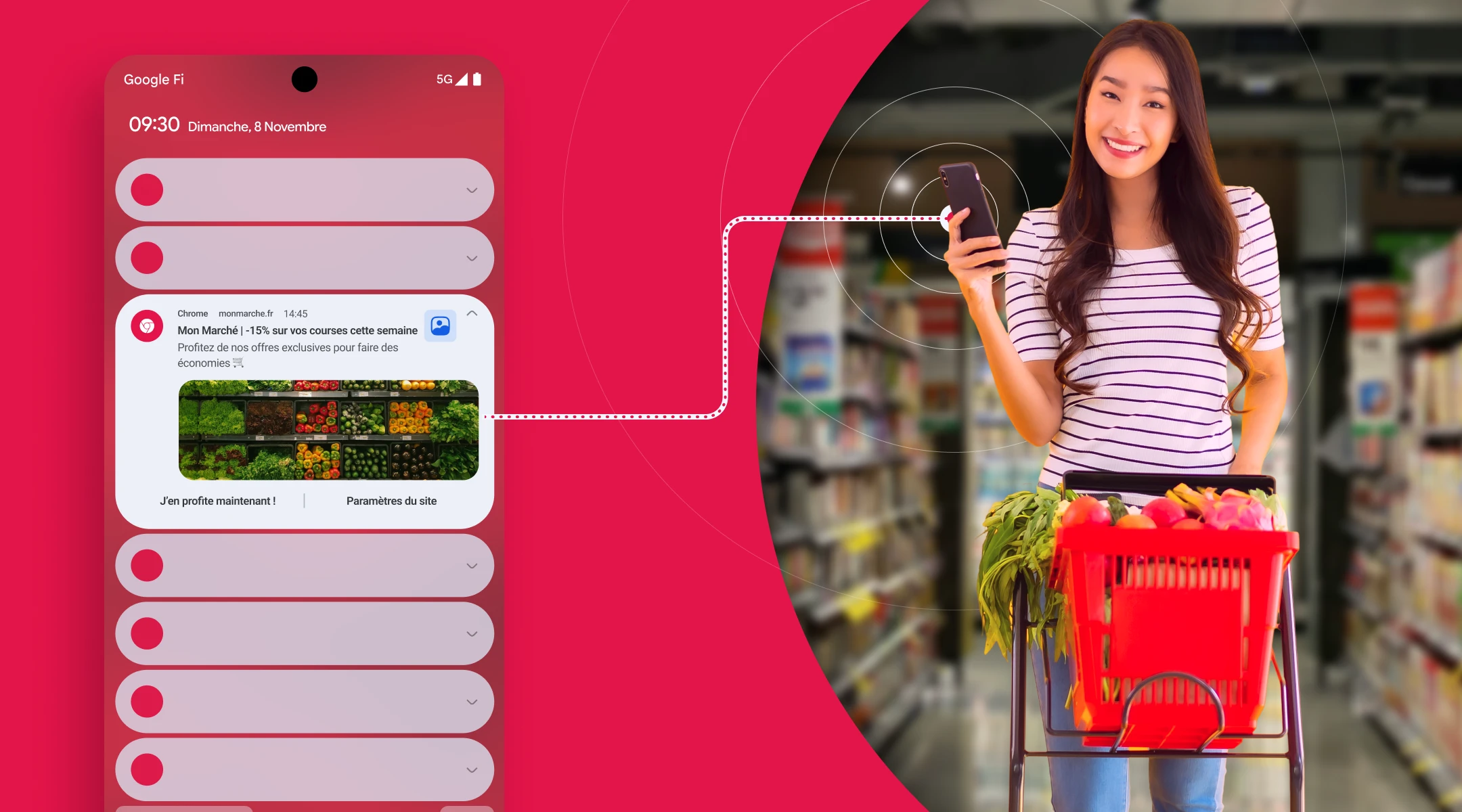
Web Push Notification deserves particular attention in the context of B2B events. It appears directly on the registrant’s screen, even if they are working on another tab — without going through a saturated inbox and without requiring their phone number.
Its key advantage for reducing no-shows: it reaches registrants who have not necessarily opened the emails. In a combined sequence, it acts as a safety net — reaching the profiles who slip through the gaps of email.
- At D-3: engagement notification (“Get an exclusive preview of the speaker’s slides”)
- At D-1 evening: reminder with direct connection or access link
- At H-1: “Your event starts in one hour, direct access here”
- At H-0 (5 min): “It’s starting! Join us now →”
Adrena’tips: Web Push is particularly effective for webinars. The registrant is often already in front of their computer when the notification arrives — one click is all it takes to open the session. The delay between notification and connection is very short.
Structural strategies to reduce no-shows at the source
The reminder sequence treats the symptom. These strategies address the root causes.
Qualify registrations from the start
Not all registrants are equal in terms of likelihood of attendance. A registration form that asks two or three questions (job title, company size, main reason for registering) allows you to identify high-intent profiles versus casual browsers. Less engaged profiles deserve different communication — more value-focused — than already-convinced attendees.
For high-stakes events (conferences, trade shows, product launches), an active confirmation — email or validation call — mechanically reduces no-shows by creating an additional level of commitment.
Introduce intentional friction for free events
Counter-intuitive but effective. For a free event, requiring an extra step at registration — email confirmation, manual validation, access code sent separately — creates a micro-commitment that filters out poorly motivated profiles. Registrants who have made even a minimal effort tend to show up more often.
Another approach: explicitly state in the confirmation “Places are limited to [X] attendees — please cancel if you cannot come.” Making the impact of their absence visible changes behaviour.
Offer the hybrid option or replay
Sometimes the absentee is not indifferent — they are someone who had a legitimate reason to be absent but did not dare or think to notify. Systematically offering a virtual participation option for in-person events, or announcing at registration that a replay will be available, changes behaviour. A registrant who knows they can catch up will not be psychologically absent — they will stay connected to your brand.
⚠️ Announcing the replay too early can paradoxically increase no-shows (= I’ll watch it later). Mention it in post-event communications, not in pre-event reminders.
Choose the right timing for your event
The day and time have a direct impact on attendance rates. Industry data converges on a few optimal slots for B2B events:
| Format | Optimal day | Optimal time | Avoid |
| B2B webinar | Tuesday, Wednesday, Thursday | 10–11am or 2–3pm | Monday morning, Friday afternoon, days before bank holidays |
| Full-day conference | Tuesday or Thursday | Start at 9am, end at 5pm | Holiday periods, long weekends |
| Professional breakfast | Tuesday or Wednesday | 8–9.30am maximum | Monday (weekly meetings), Friday (weekend departures) |
| Round table / workshop | Wednesday or Thursday | 2–4.30pm | End of week, eve of school holidays |
Creating engagement before the day
An engaged registrant is an attending registrant. The goal is not just to send reminders — it is to make the registrant look forward to your event with interest, even eagerness. Here are the engagement mechanics that work.
The content preview
Send your registrants exclusive content they cannot get anywhere else: the speaker’s preparatory slides, a 2-minute video excerpt from the previous conference, an in-depth article related to the theme. This content creates value even before the event and reinforces the attendee’s identity: “I am someone registered for this event”, “I have received exclusive resources.”
Involving registrants in the programme
Ask registrants to submit their questions to the speaker in advance. Run a poll on the topics to explore. Publish the results in the next reminder. This mechanic creates a double effect: the registrant feels like a co-author of the event and wants to come to see if their question is addressed.
Creating FOMO (Fear Of Missing Out)
Share popularity indicators for the event: “Over 400 professionals registered”, “3 major companies represented”, “Speaker #2 just confirmed”. These elements reinforce the event’s legitimacy and the feeling that not attending would be a real loss.
After each edition, systematically share photos, attendee quotes and key figures with your no-shows. This post-event content is one of the best investments for reducing no-shows at the next edition.
The pre-event community
For recurring events (annual conferences, webinar series), create a space for registrants to interact before the event: LinkedIn group, Slack channel, dedicated thread. Attendees who have already interacted with other registrants almost always show up. The community dimension creates an engagement that content alone cannot generate.
Converting no-shows after the event
A no-show is not a lost prospect — it is a qualified contact who expressed enough interest to register. Handled well after the event, they can become one of the most loyal attendees at the next edition.
Post-event communication for absentees
Send no-shows a separate email from the one sent to attendees. Do not send them the same message — acknowledge their absence and offer an alternative:
- The replay or summary: “You weren’t able to join us — here is the session replay and the resources shared by the speaker.”
- Key takeaways in short format: 3 to 5 insights from the event, presented as a list or infographic. Easy to consume, high perceived value.
- Direct invitation to the next event: “The next edition will take place on [date] — register as a priority.” A no-show who re-registers is a strong signal of genuine interest.
Segment your follow-up by absence profile
| Profile | Signal | Recommended action |
| Early registrant, did not open reminders | Low engagement in the sequence | Rework targeting and content of the sequence |
| Recent registrant, opened reminders but absent | Last-minute obstacle likely | Personalised email + replay + invitation to next event |
| Cancelled before the event | Voluntary disengagement or scheduling conflict | Understand the reason (micro-survey), re-register for next edition |
| Recurring no-show (2nd or 3rd time) | Poorly qualified profile or recurring bad timing | Remove from list or offer replay only |
💡 Data shows that 63% of webinar viewings happen on demand (replay) after the event. Your no-show can still consume your content and become a lead — if they receive the right message at the right time afterwards.
The KPIs to track for your anti-no-show strategy
| KPI | Formula | Target / Benchmark | Measurement tool |
| No-show rate | (Absent without notice ÷ Registrants) × 100 | < 20% (good) / < 35% (acceptable) | Event platform |
| Attendance rate | (Present ÷ Registrants) × 100 | > 50% webinar / > 60% paid in-person | Event platform |
| Reminder open rate | Emails opened ÷ Emails sent | > 40% for D-1 and D-0 reminders | CRM / email tool |
| Reminder click rate | Event link clicks ÷ Emails sent | > 10% on direct connection links | CRM / email tool |
| Cancellation rate | Cancellations ÷ Registrants | < 15% (signal of clear communication) | Registration platform |
| Replay rate | Replay views ÷ No-shows | > 30% (absentees catching up) | Video platform / analytics |
| Re-registration rate | No-shows re-registered for next edition ÷ No-shows | Target: > 20% | CRM / registrant database |
📊 Always measure your no-show rate after each event and compare it to the previous edition. The trend over 3 to 5 events is more useful than the absolute figure — it shows whether your communication adjustments are having an effect.
Web Push in your anti-no-show arsenal
Among the available reminder channels, Web Push occupies a particular place: it is the only one that appears on your registrant’s screen in real time, with no competition from other emails in an inbox, and with no per-send unit cost.
With Adrenalead, you can configure automated scenarios triggered according to your event’s timing: D-3, D-1, H-1 and H-0 notifications. These reminders reach your registrants even if they have not opened your emails — precisely the profiles most at risk of no-showing.
| Web Push advantage | Concrete benefit for events |
| Immediate on-screen display | The registrant sees the reminder even if they are in a meeting or on another site |
| No inbox, bypasses spam | Reaches profiles who have not necessarily opened the reminder emails |
| 1-click opt-in, no email needed | Reachable even if the email address is out of date |
| Short and direct message | Ideal for urgent H-1 and H-0 reminders (direct link clearly visible) |
| Automatable via scenario | Reminder sequence configured once, reusable for each edition |
What is a normal no-show rate for a B2B webinar?
2026 benchmarks indicate an average attendance rate of between 30 and 50% for B2B webinars, meaning 50 to 70% of registrants are absent live. This rate varies noticeably by sector: pharma achieves around 50% attendance, while software and services can drop to 28%.
An attendance rate above 50% is considered good performance. For paid in-person events, the target is to stay below 20% no-shows.
How many reminders should you send without wearing out registrants?
Between 5 and 7 messages over the entire pre-event period for a webinar, spread across a typical sequence:
- D-14 — Registration confirmation and first practical information
- D-7 — Highlight of exclusive content or a confirmed speaker
- D-3 — Reminder with added-value elements
- D-1 — Connection reminder and technical information
- D-0 morning — Final day-of reminder
- H-1 — Imminent start reminder
For a multi-day in-person event, a longer sequence — up to 14 messages before the event — is justified. The golden rule: every message must provide practical information, exclusive content or a speaker confirmation — not just a simple “don’t forget.”
Should you penalise no-shows to discourage them?
For free events, a symbolic penalty can be considered: having to explicitly re-register for the next edition, or losing access to the replay. This approach naturally selects genuinely engaged profiles.
However, it must be communicated clearly from the registration page, so it is not perceived as punitive after the fact. The goal is to qualify your audience, not to create frustration around your brand.
Does the replay hurt live attendance rates?
If the replay is announced before the event as an equivalent alternative, then yes: some registrants will prefer to “watch later” and will never attend — neither live nor on demand.
Best practice is not to highlight the replay in pre-event communications, but to send it systematically to no-shows after the session. This captures their interest without sacrificing the live attendance rate — and turns an absentee into a warmed-up lead.
How do you measure the impact of your actions on the no-show rate?
Compare your attendance rate edition by edition, isolating the variables: change of reminder channel, modification of send timing, addition of exclusive content. An improvement is only significant if the other parameters have remained constant.
Also track the open rate of each reminder email in the sequence. A marked drop at D-3 or D-1 indicates a content or subject line problem — not necessarily a lack of interest in the event itself. That is an optimisation signal to address before the next edition.
It is not inevitable! It is time to reduce your no-show rate
No-shows are not an inevitability of B2B events — they are the result of engagement that is insufficiently maintained between registration and the day itself. In a saturated professional schedule, an event that does not communicate regularly becomes invisible.
The recipe for significantly reducing them is well established: qualify registrations from the start, build a progressive communication sequence with the right channel at the right time (email for depth, SMS and Web Push for urgency), create engagement with exclusive content, and convert absentees after the event into loyal attendees.
A well-managed no-show rate also means a better reading of your event ROI, better-sized teams and speakers who face a full room — in person and online.
Sources
Source: Livestorm, Webinar statistics and attendance rates
Source: Zoom, Key webinar figures 2026
Source: GoToWebinar, Webinar attendance benchmarks
Source: Oniva Events, Reducing the event no-show rate 2026
Source: Eventdrive, Impact of no-shows on virtual events
Source: Lyyti, Anti-no-show tips for event organisers
Source: Eventrize, B2B event no-shows