Your shop is generating traffic. Visitors select items, progress to checkout… Then disappear. This cart abandonment phenomenon represents, according to the Baymard Institute, 70.19% of e-commerce sessions worldwide.
For a site generating £15,000 in monthly revenue, recovering just 25% would generate £45,000 in additional annual turnover. This guide explains why your visitors leave, how to retain them and, if they’ve already gone, how to bring them back.
- Definition and calculation of the abandonment rate
- Key statistics
- Why do your visitors leave?
- Reducing the abandonment rate upstream
- The recovery sequence: email + Web Push
- Examples of recovery messages
- Recommended tools
- Visual content elements to integrate into any abandoned cart recovery solution
- Adrenalead Web Push: recover visits with no contact details
- Frequently asked questions about abandoned carts
- Your abandoned carts are not a fatality!
Definition and calculation of the abandonment rate
A visitor adds items, starts the order process, then leaves the site without buying. This behaviour is measured through a simple indicator:
Abandonment rate = (Unfinished orders ÷ Initiated orders) × 100
Two variants exist: leaving the site after filling a selection, or abandoning the checkout funnel mid-way. Both deserve a distinct approach.
💡 Adrena’tips: segment this KPI by device in GA4, as a mobile buyer abandons for very different reasons than a desktop buyer.
Key statistics
These figures help you assess your performance and prioritise your actions.
| Indicator | Figure |
| Global average cart abandonment rate | 70.19% |
| On smartphone | ~80% |
| On desktop | ~65 to 68% |
| Cause #1: unexpected fees | 48% of cases |
| Refusal to create an account | 24% of cases |
| Reminder email open rate | 50.5 to 54% |
| Average revenue per recipient | $3.65 |
| Re-conversions via an email sequence | 17.6% |
| Non-purchase if preferred delivery absent | 81% |
By sector
Luxury and fashion record the highest rates — hesitation increases with the amount at stake. Pet care and everyday products are significantly lower.
| Sector | Average cart abandonment rate |
| Luxury & jewellery | 74.88% |
| Fashion & accessories | 72.74% |
| Beauty & skincare | 72.04% |
| Online food & grocery | 72.26% |
| General retail | 67.98% |
| Pet care | 64.39% |
Why do your visitors leave?
The Baymard Institute identified seven main reasons across more than 49 studies. Here they are, from most to least frequent.
1. Fees discovered at the last moment, 48% of cases
The unpleasant surprise is the primary trigger for departure: delivery charges, taxes or surcharges that only appear at the final checkout step. The price displayed on the product page no longer matches the amount requested — the visitor leaves immediately.
💡 Adrena’tips: display the total cost (including delivery) from the product page. Price transparency measurably reduces the drop-off rate at checkout.
2. Mandatory account creation, 24% of cases
Many people refuse to register just to place a single order. On mobile, entering personal information is even more off-putting. The solution: guest checkout, with an invitation to create an account after the purchase is completed.
3. Checkout process too long
Every superfluous step in the funnel increases the risk of drop-off. The 2025 standard: three steps maximum, form reduced to 8 fields (Baymard recommendation), visible progress bar.
4. Lack of trust at checkout
A lesser-known site must display its trust signals before the customer enters their payment details: SSL badge, Visa/Mastercard/PayPal logos, clear returns policy, verified reviews.
5. Insufficient delivery options
Among regular online shoppers, delivery cost is frequently cited as the top criteria. Offering several options (home delivery, collection point, express) at transparent prices is a direct conversion lever.
6. Poor smartphone experience
With 80% non-completion on mobile, tactile optimisation is no longer optional. Buttons that are too small, complex forms, slow loading: these frictions drive users away before they even reach checkout.
7. Comparative browsing without immediate intent
Some visitors use their selection as a wish list or to compare prices across competing sites. These profiles respond better to a gentle, value-focused re-engagement rather than an urgent incentive.
Reducing the abandonment rate upstream
Preventive optimisations are the most cost-effective: they avoid the loss before it occurs. Here are the four priority areas.
Price transparency
- Delivery cost displayed from the product page
- Free delivery threshold clearly visible (e.g.: free delivery from £50)
- Delivery times and options available before the confirmation step
Simplified checkout
- Guest checkout: non-negotiable for a good experience
- Form reduced to the strict minimum
- Apple Pay and Google Pay integrated for smartphone orders
- Progress indicator at each step
Visual reassurance
- SSL certificate and payment logos clearly visible
- Returns policy prominently featured. Worth knowing: free returns are a decisive argument
- Customer reviews displayed at the point of confirmation
Mobile performance
- Adapted tactile interface, large buttons, smooth reading
- Optimised loading time: every additional second of delay reduces conversions
The recovery sequence: email + Web Push
Even with a perfect funnel, some visitors will leave. Recovery consists of re-engaging them via two complementary channels: email for identified contacts and Web Push for anonymous visitors who have accepted browser notifications.
A 3-message sequence
Three sends spaced over 72 hours generate up to 29% more conversions compared to a single message, according to industry data.
| Send | Timing | Content | Tone |
| Message 1 | 30 min – 1h | Reminder of the selection, product visual, direct CTA | Friendly |
| Message 2 | 24h later | Reassurance: delivery, returns, customer reviews | Reassuring |
| Message 3 | 48 – 72h later | Price offer or free delivery, urgency | Incentivising |
📊 According to SaleCycle, the first message sent 20 minutes after departure converts at 5.2%, compared to 2.6% after 24 hours. Act fast.
Writing the subject line that gets opens
For email, the subject line is the only visible element before opening. Five formulas that perform:
- First name + reminder: “[First name], your selection is waiting for you 🛒”
- Playful tone: “We saved your spot… For now”
- Scarcity: “Only 3 left in stock”
- Price offer: “Free delivery, 24 hours only”
- Dialogue: “Something hold you back?”
Web Push: the reminder for visitors without an email address
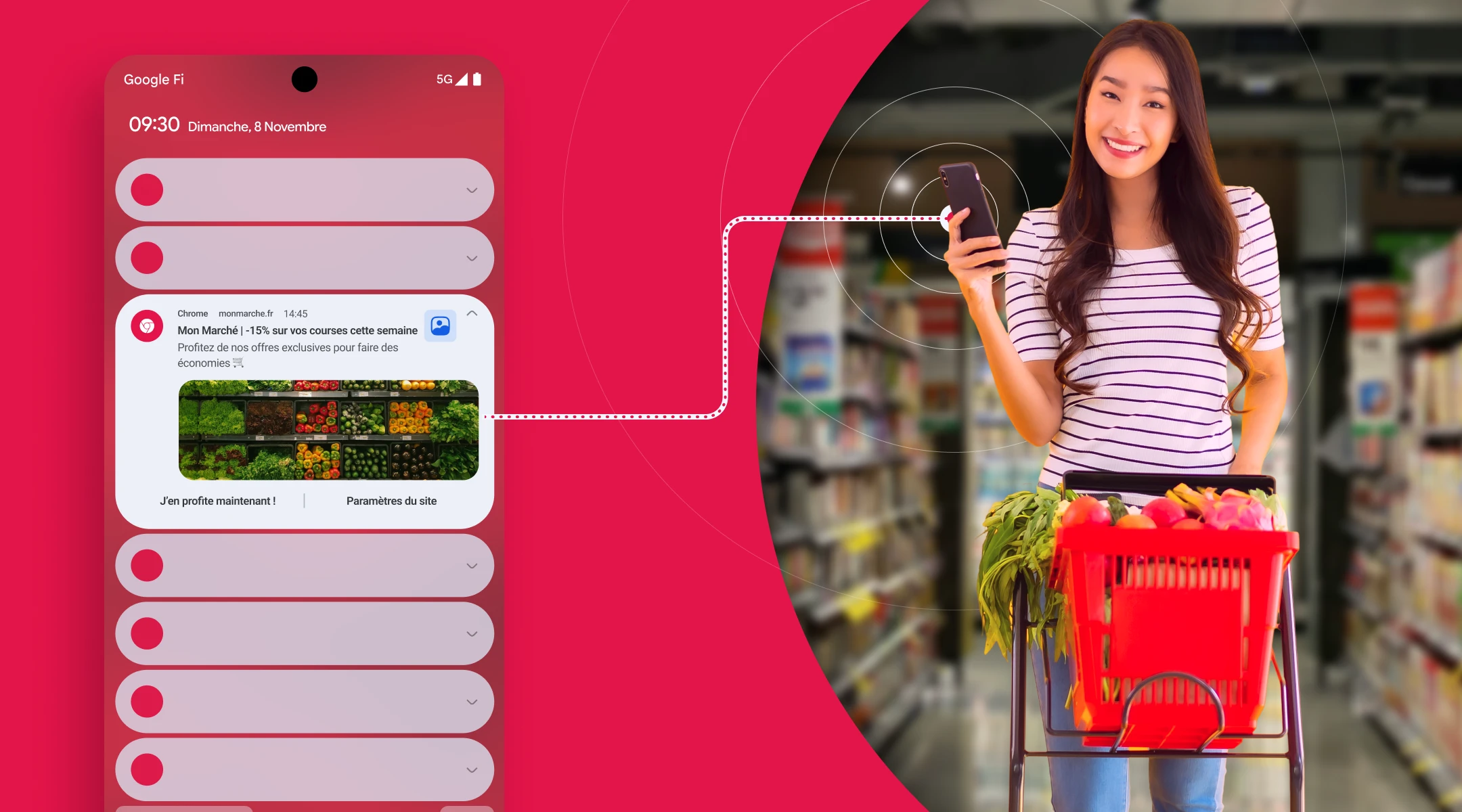
Email requires knowing the visitor’s contact details. A push notification only requires acceptance of notifications from your site (one click only!). The message appears directly on screen, in real time, with no third-party cookie or stored personal data.
| Channel | Prerequisite | Timing | Key strength |
| Known address | 30 min – 72h | Rich content, long sequence | |
| Web Push | Browser consent | < 30 min | Immediate, anonymous, cookie-free |
| Both | Email OR consent | Push first | Maximum coverage |
Recommended full scenario
- Within 30 minutes: Web Push reminder — product visual, direct return button
- At 1 hour: first email — friendly message, no discount
- Day +1: second email — reassurance (delivery, returns, trust)
- Day +3: third email + Web Push — price offer, limited-time deadline
💡 Adrena’tips: automatically exclude buyers who have completed their purchase between sends. A notification received after a purchase degrades the experience.
Examples of recovery messages
First message: simple reminder
Subject: Sophie, your selection is waiting for you 🛒
Body: Hi Sophie, You left something behind! [Product visual], [Name], [Price] → Resume my order. See you soon, The [Brand] team
What works: personalised subject line, visual centred on the items left behind, a single action button. No discount at this stage — purchase intent is still fresh.
Second message: reassurance
Subject: Free delivery, free returns — everything you need to know 🚚 Your selection is still available. Before you decide, here’s what our customers love: ✅ Free delivery from [X]£ ✅ Free returns within 30 days, no conditions ✅ 100% secure payment (SSL) ✅ 4.8/5 from [X] verified reviews → Complete my order. Questions? Our team responds in under 2 hours. The [Brand] team
What works: the three main barriers to purchase are addressed directly (delivery, returns, security) without mentioning the abandonment. The tone is helpful, not commercial. Customer reviews provide social proof at exactly the right moment.
Third message: final incentive
Subject: Last reminder — free delivery on your order (24h)
Body: Your selection is still there. To help you decide, we’re offering you free delivery! Code: DELIVERY (valid until tomorrow) → Complete my purchase ⭐ 4.8/5 · 🔒 Secure payment · 📦 Free returns 30 days
Price offer visible from the subject line, reassurance grouped at the bottom of the message, time-limited urgency.
Web Push notification
Title: Your selection is waiting for you!
Description: [Product] is still available. Complete your purchase now. → View my selection
Displayed within 30 minutes, even if the visitor is browsing another site. Short format, non-intrusive, disappears within seconds.
Recommended tools
| Tool | Speciality | Ideal for |
| Klaviyo | Email & SMS automation | Shopify / WooCommerce, advanced personalisation |
| Brevo | Email, SMS, workflows | SMEs, good value for money |
| Adrenalead | Web Push | Immediate reminder for anonymous visitors. Shopify, PrestaShop or WooCommerce stores. |
| Shopify Email | Native email | Shopify stores, quick start |
| GA4 | Analytics | Rate measurement and conversion tracking |
Visual content elements to integrate into any abandoned cart recovery solution
| Element | Role / Added value |
|---|---|
| Header | Creates visual consistency |
| Image | Visually recalls the abandoned product |
| Link / CTA | Facilitates direct conversion |
| Document | Guide, product sheet, comparison test |
| Customer review | Reassures, adds value to your product |
| Clear text | Structures the marketing message |
| Style | Sets the tone (formal, fun, minimalist, etc.) |
| List | Allows product benefits to be presented clearly |
All these elements must be optimised for mobile, fast to load and consistent with your brand identity.
Adrenalead Web Push: recover visits with no contact details
Most re-engagement tools require an email address. Yet many departures happen before the visitor has entered anything at all. These profiles are out of reach of classic email campaigns.
Web Push bypasses this problem. A single click on “Allow notifications” is enough to make the visitor reachable. When they leave their selection, a message appears on their screen in real time: no personal data required, no third-party cookie, native GDPR compliance.
- Triggered within 30 minutes, while intent is still warm
- Not blockable by ad blockers
- Complementary to email: covers anonymous profiles outside your CRM
💡 Adrena’tips: Web Push recovery campaigns display a CTR above 4% and a conversion rate above 10%, with no third-party cookie.
Frequently asked questions about abandoned carts
What cart abandonment rate should be considered normal?
Below 70%, you are under the global average — that’s already a good baseline. On desktop, a rate of 60 to 65% is achievable with a well-designed checkout funnel.
The goal isn’t to reach zero abandonment, but to recover a fraction of unfinished sales. Even a modest recovery rate on a significant volume can represent meaningful incremental revenue.
When should the first re-engagement message be sent after a cart abandonment?
As soon as possible: ideally within 30 minutes of the abandonment. After an hour, purchase intent starts to wane and conversion chances drop significantly.
Web Push is particularly well-suited to this reactivity: triggering can be near-immediate after abandonment is detected, without requiring the visitor to still be on the site.
How many re-engagement messages should be sent after a cart abandonment?
Three messages over 72 hours is the industry standard. Beyond that, the risk of unsubscribing outweighs the potential conversion gain.
The angle of each send should evolve to avoid repeating the same message:
- Message 1 — The simple reminder: a friendly reminder of the items left in the cart.
- Message 2 — Reassurance: removing potential barriers (free returns, customer reviews, guarantees).
- Message 3 — Price incentive: reserved for those who are still undecided, with a time-limited offer or discount.
Should a discount be offered in the first re-engagement message?
No. Many abandonments are simply cases of forgetting: a friendly reminder is enough to bring the visitor back and complete their order — without eating into your margins.
Reserve the commercial offer for the third message, for those who have resisted the first two re-engagements. Using a discount in the very first send trains your customers to systematically wait for a reduction before buying.
Is abandoned cart recovery GDPR-compliant?
Yes, provided the correct prerequisites are met depending on the channel used:
- Email: the visitor must have entered their details at a previous step in the funnel (account creation, start of the order form). Without an address collected with consent, no re-engagement is possible.
- Web Push: browser consent, obtained with a single click during a previous visit, is sufficient. It is the most naturally GDPR-compliant channel, since the browser itself acts as a trusted third party for collecting consent.
How do you measure the ROI of an abandoned cart recovery strategy?
Three key indicators should be tracked as a priority:
- Recovery rate: the share of re-engaged abandonments that ultimately completed their order.
- Incremental revenue: revenue generated solely through re-engagement, isolated from organic traffic.
- Cost per recovered order: to assess the true profitability of the system relative to any discounts granted.
On the technical side, create dedicated cart recovery events in GA4 with distinct UTM parameters per channel (email, Web Push, SMS). This allows each conversion to be attributed to its re-engagement source, enabling you to optimise your investment accordingly.
Your abandoned carts are not a fatality!
A rate of 70% does not mean 70% of revenue permanently lost. With an optimised funnel and a structured re-engagement strategy, it is possible to recover a significant share at low cost.
The email + Web Push combination covers all profiles — identified contacts as well as anonymous visitors — and generates one of the highest returns on investment in e-commerce marketing.
Sources
Source: Baymard Institute, Cart Abandonment Rate
Source: Shopify, Cart Abandonment Statistics (2024)
Source: Klaviyo, Benchmark Report 2024
Source: SaleCycle, Re-engagement Benchmarks 2024
Source: Vibetrace, Abandonment Rate by Sector
Source: Thunderbit, 25 Statistics 2025
Source: Payplug, Abandoned Cart Re-engagement