🕒 Updated October 16, 2025
Why (re)talk about remarketing in 2025 – 2026?
You invest time and budget in deploying the best strategies to attract visitors to your website… And then the majority leave without converting. Remarketing (or retargeting) serves precisely to re-engage those who have already shown an interest in your brand (visit, analytical action, email opening, opt-in, etc.) in order to obtain a return, registration, sale or re-purchase.
In 2025, this is a pivotal lever in the digital mix: it maximizes the ROI of acquisition efforts, adapts to the “post-cookies” context, and increasingly relies on first-party/zero-party data, AI and opt-in channels.
- Why (re)talk about remarketing in 2025 – 2026?
- Definition: remarketing vs. retargeting (simple clarification)
- Typical objectives (and how to measure them)
- Visual performance summary by remarketing channel
- Steps to a successful remarketing campaign
- The steps of a successful remarketing campaign
- How can you measure the effectiveness of your remarketing campaigns?
- Remarketing channels: strengths, limitations and use cases
- Comparison of remarketing channels
- Operational zooms
- Best practices (2025)
- Real-World Examples of Remarketing Strategies by Industry
- Examples of Web Push notifications for acquiring new prospects
- Frequent errors & quick fixes
- Trends 2025: « cookieless », AI and omnichannel
- Tools & platforms (2025 toolbox)
- Web Push by Adrenalead (powerful alternative & RGPD compliant)
- Smarter, more responsible remarketing… and better performance
- Maximize my remarketingwith Web Push!
- Frequently asked questions about remarketing
Definition: remarketing vs. retargeting (simple clarification)
Retargeting
/ advertising retargeting /
Delivery of targeted ads to anonymous visitors, often via cookies or equivalents, to bring them back after a visit without conversion.
- Audience
- Anonymous visitors
- Typical channel
- Dynamic display banners
- Example
- Show the viewed product on other sites.
Remarketing
/ audience reactivation /
All actions aimed at reactivating an already engaged audience: customers, identified leads or recent visitors.
- Audience
- Customers, leads, known visitors
- Typical channels
- Email, SMS, Web Push, CRM, social, display
- Data base
- First-party data, lists and consents.
The two terms are often mixed up, especially because Google Ads uses “remarketing” for its audience lists.
Re-engage someone already exposed to the brand to increase the probability of conversion.
In practice, the two terms are often confused (Google Ads uses « Remarketing » for its audience lists). Remember the common intention: to remarket to a person already exposed to the brand, in order to increase the probability of conversion.
Typical objectives (and how to measure them)
Visual performance summary by remarketing channel
- CTR
- > 4 %
- Conversion
- > 10 %
Reach x3, reduced CPA
- CTR
- 15 – 25 %
- Conversion
- 3 – 8 %
Very low cost/lead on an opt-in base
- CTR
- 0,7 – 1,2 %
- Conversion
- 2 – 5 %
+50 to +100% vs cold campaign
- CTR
- 1 – 3 %
- Conversion
- 2 – 6 %
Strong in e-commerce (DPA)
- CTR
- N/A
- Conversion
- +30 – 50 % vs standard Search
Optimized bids
- Convert first purchase / first contact. KPIs: conversion rate, CPA/ROAS, conversion time, share of assisted conversions.
- Reactivate dormant customers / increase purchase frequency. KPI: re-purchase rate, CLV, RFM, incremental revenue.
- Generate registrations (demo, trial, event, newsletter). KPI: registration rate, cost per qualified lead, post-registration activation rate.
- Educate/nurture in a long cycle (B2B, automotive, education). KPI: stage progression (MQL→SQL), content engagement, cycle time, influenced pipeline.
Steps to a successful remarketing campaign
The steps of a successful remarketing campaign
-
01 Scoping
Set a clear direction
Define one SMART objective per campaign, then connect it to measurable KPIs.
- Conversion, CTR, CPA/ROAS, repeat purchase.
- View-through if the journey justifies it.
-
02 Segmentation
Segment your audiences
Create useful lists that are precise enough to adapt the message without making the campaign unreadable.
- 30-day visitors, cart abandoners, category readers.
- 90-day inactive customers, leads who downloaded a guide.
-
03 Orchestration
Choose the right channels
Select the mix based on segment value, intent and activation cost.
- Display/YouTube, Social, Email/SMS, Web Push.
- Marketing automation, CRM onboarding, Customer Match.
-
04 Data
Set up tracking & compliance
Secure measurement before launch, with clear consent governance.
- Tags/pixels, push script, UTM.
- Consent Mode, hashing, preference page, fresh data.
-
05 Creation
Create contextualized messages
Align the offer, visual and CTA with each audience’s real behavior.
- Dynamic creatives, social proof, segmented offers.
- Clear CTAs, frequency capping, native formats by channel.
-
06 Management
Launch, analyze, optimize continuously
Evolve the campaign based on business signals instead of freezing the initial plan.
- A/B iterations: hooks, images, timing, offers.
- Bid adjustments, budgets, exclusion of converters.
How can you measure the effectiveness of your remarketing campaigns?
Measuring incremental impact is key. Here are the KPIs to monitor based on your objective:
| Objective | Main KPI | Secondary KPIs | Measurement tool |
|---|---|---|---|
| E-commerce conversion | ROAS / CPA | Recovered cart rate, incremental revenue | GA4, Google Ads, Meta Ads |
| Lead generation | Cost per qualified lead | Signup rate, conversion delay | CRM + UTM tracking |
| Retention / repeat purchase | CLV, repeat purchase rate | RFM, purchase frequency | CRM + segments comportementaux |
| Recall awareness | View-through conversions | Brand search uplift, memorization | GA4 + control group test |
| Drive-to-store | Incremental in-store visits | Scanned coupon/QR, offline revenue | Offline attribution (GCLID, QR) |
Adrena’tips: Avoid limiting yourself to “last-click” metrics. Use a multi-touch attribution model (data-driven in GA4) to measure the actual contribution of each remarketing channel in the conversion funnel.
Remarketing channels: strengths, limitations and use cases
Comparison of remarketing channels

Display/YouTube
Google Ads
Massive reach, visual/video formats, RLSA
Post-cookie constraints, perceived pressure if poorly paced
Abandoned cart, product follow-up, recall awareness

Meta
Facebook / Instagram
Engaging formats: stories, carousel, social signals
Variable CPMs, depends on pixel and creative quality
E-commerce DPA, content follow-up, newsletter signup

LinkedIn Ads
B2B & ABM
B2B targeting: role, industry, account, nurturing
High CPCs, smaller audiences
SaaS demo, white paper, ABM
Email/SMS/Automation
Relationship marketing
Direct relationship, rich personalization, low unit costs
Requires opt-in, possible saturation
Abandoned cart, customer reactivation, nurturing
Web Push
Browser
Native browser opt-in, real time, adblock bypass, cookieless
Requires opt-in, short messages
Stock/price alerts, new content, targeted offers
CRM onboarding
Customer Match
Large-scale first-party data activation
Variable match rate, GDPR requirements
Dormant customer reactivation, VIP campaigns
Operational zooms
A. Google Ads (Display & RLSA)
- Tagging (Google Tag/GA4) and audiences(all 30-day visitors, shopping cart abandonment, etc.).
- Display campaigns targeting your lists; RLSA to adjust bids/search ads with existing visitors.
- Responsive creatives (multiple assets) + capping (e.g. 5 impressions/user/7 days).
- Optimization: placements, bids, extensions to YouTube if audience is large.
B. Web Push (browser)
- Choose platform
- Collect opt-in (native browser window): up to ~15% opt-in rate, often much higher than email
- Segment by behavior(page views, categories, shopping cart…).
- Scenarios: abandoned cart trigger, stock/price alert, new content, J-X promo.
- Measures: high CTR and read rates.
- Key benefits: not blocked by adblockers, 100% brand safety (system notification), RGPD compliant with native opt-in.
C. CRM onboarding & Email/SMS
- Onboarding: upload encrypted lists (hashed emails), match rate 30-70% depending on platforms; target inactive 90 days, VIP, upsell.
- Email/SMS: workflows for abandonment, reactivation, post-purchase (cross-sell), event notifications. Benchmark retention: email retargeting remains a mainstay.
Best practices (2025)
- Segment more finely (value, intent, recency, frequency, monetary).
- Personalize (creative, offer, timing) according to context (product seen, category read, industry).
- Control pressure (capping/inclusion days) to avoid irritation.
- Renew creative (avoid banner blindness).
- Test/iterate (A/B bidding CPC vs CPA, offer %, free shipping, message “social proof”…).
- Track the right KPIs (CTR, conversions, CPA/ROAS, view-through where relevant, site return rate).
- Experience first: useful, non-intrusive, exclude converts or switch to cross-sell.
- Compliance by design (explicit consents, Consent Mode, unsubscribe links, preferences page).
Real-World Examples of Remarketing Strategies by Industry
Remarketing is not a one-size-fits-all approach: it adapts to the challenges, buying cycles, and behaviors specific to each industry. Here are some operational scenarios by industry.
| Sector | Trigger | Recommended channel | Sample message | Target KPI |
|---|---|---|---|---|
| E-commerce / Fashion | Cart abandonment or viewed product page | Web Push + Email + Dynamic Display | “Your selection is waiting — 10% off for 24h” | Recovered cart rate, ROAS |
| Travel / Tourism | Destination search without booking | Display Remarketing + Web Push | “Last seats Paris-Lisbon at -30%” | Incremental booking, CPA |
| Banking / Insurance | Unfinished online simulation | Email + Web Push + RLSA | “Your simulation is ready — An advisor is available” | Qualified leads, appointments booked |
| B2B / SaaS | Pricing page visit or white paper download | LinkedIn Ads + Email automation | “14-day free trial — No credit card” | MQL → SQL, activation rate |
| Retail | Viewed category or unclicked promotion | Web Push + Display local | “Flash promo this weekend in your store” | Drive-to-store visits, incremental revenue |
| Media / Publishers | Reader inactive for 14 days | Web Push + Email | “3 articles you missed this week” | Return rate, page views |
Example of Web Push Remarketing by Industry
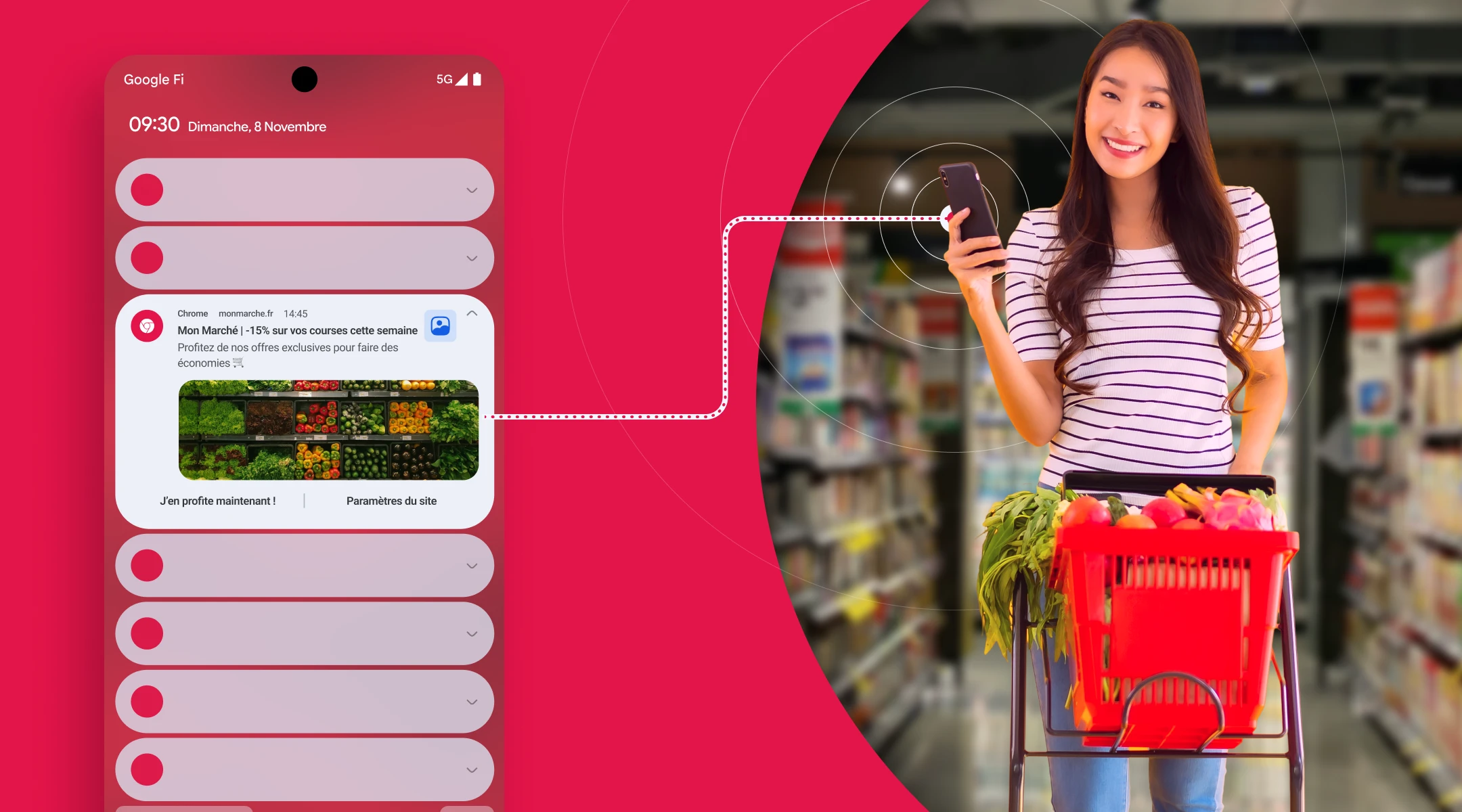
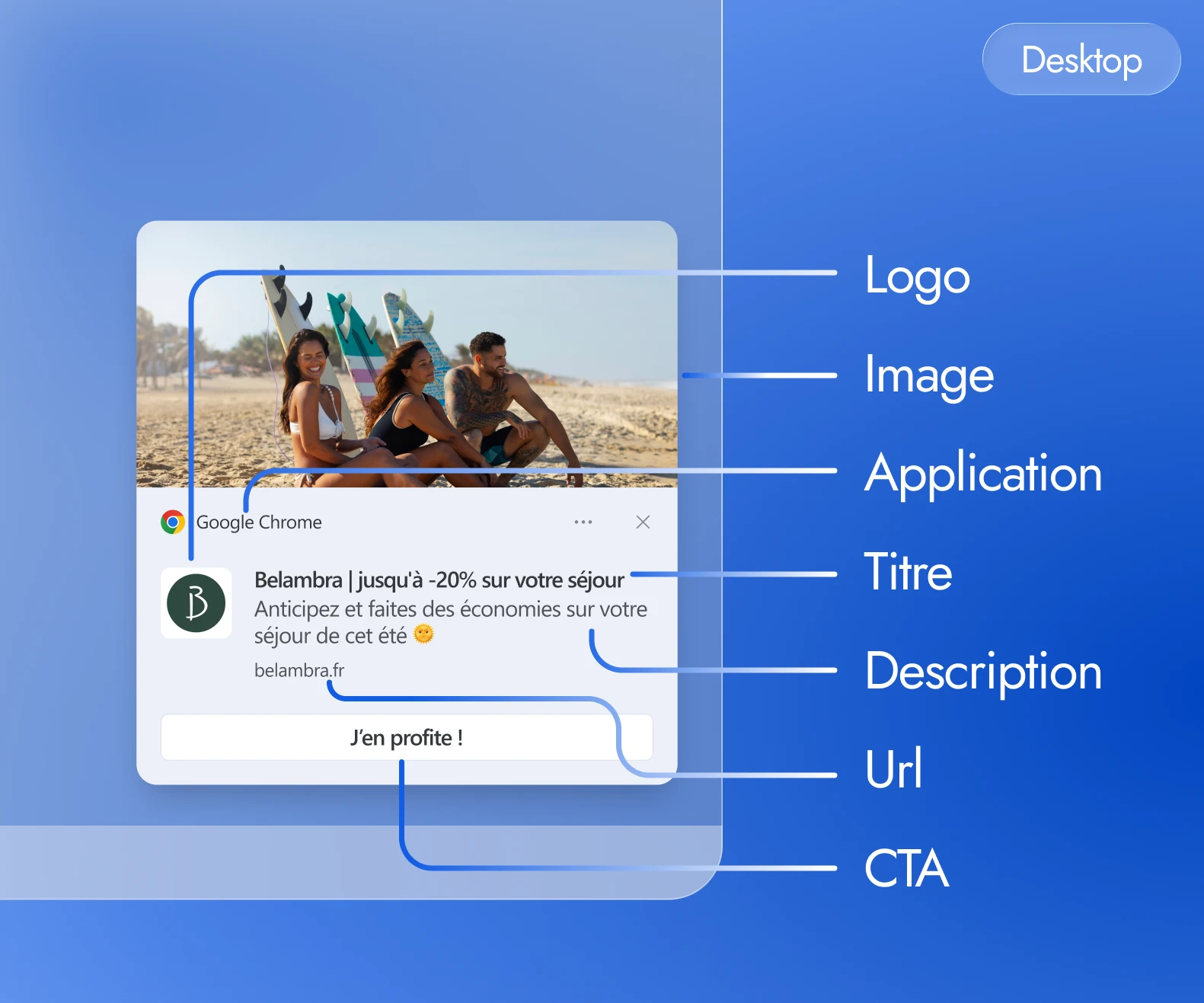
Examples of Web Push notifications for acquiring new prospects

 Google Chrome
E-commerce / Fashion
Frequent errors & quick fixes
| Problem | Impact | Recommended fix |
|---|---|---|
| Unclear objective | Impossible optimization, diluted budget | 1 SMART objective / campaign + prioritized KPIs |
| Audience too broad/old | Low relevance, high CPA | Precise segments + recency ≤ 15–30 days (depending on cycle) |
| Overexposure | Irritation, lower CTR, negative image | Capping (e.g. 3/day), limited inclusion window |
| Forgetting to exclude converters | Budget waste, customer frustration | Exclusion lists + cross-sell scenarios |
| Generic creatives | Low perceived relevance | DCO, social proof, clear benefits by segment |
| No iteration | Eroding performance | A/B creatives/offers/channels every 2–4 weeks |
| Neglected compliance | Legal risk, loss of trust | Explicit opt-ins, CMP, consent logs, Consent Mode |
Trends 2025: « cookieless », AI and omnichannel
1) After third-party cookies, first-party/zero-party resilience
- Safari/Firefox already block third-party cookies; Chrome is gradually phasing them out.
- Response: first-party data, loyalty programs, zero-party (declarative preferences), CDP to unify & activate in real time.
- Contextual targeting (boosted by AI) + alternative IDs (Customer Match, UID 2.0, Topics API) depending on your legal framework and resources.
2) AI & machine learning everywhere
- Predictive segmentation and scoring, DCO (dynamic creative), intelligent auctions.
- Typical gains reported by 2025 benchmarks: +CTR and +post-click conversions with AI.
- Ethics/transparency: don’t over-customize to the point of being perceived as intrusive.
3) Omnichannel & unified customer journey
- Synchronize email / push / social / display / search / offline.
- Automatically stop pressure when a conversion occurs elsewhere.
- Cross-device via logged ecosystems (Google/Meta/LinkedIn).
- Phygital: drive-to-store & online↔offline attribution.
4) Privacy = competitive advantage
- Explicit consent, UI without dark patterns, clear preferences, compliant partners (IAB TCF, Consent Mode).
- Reference: reinforced obligations.
Tools & platforms (2025 toolbox)
- Google Ads (Display, YouTube, RLSA, Customer Match).
- Meta Ads (Facebook/Instagram, DPA, Stories).
- LinkedIn Ads (B2B, ABM, Lead Gen Forms).
- Criteo, AdRoll (programmatic retargeting).
- Email/SMS & automation: HubSpot, Klaviyo, Mailchimp, Sendinblue, SFMC.
- Web Push: Adrenalead (collection, segmentation, campaigns, audience network).
- Analytics & attribution: GA4, attribution models, Mixpanel/Amplitude, Data connectors.
Web Push by Adrenalead (powerful alternative & RGPD compliant)
Totally decoupled from browsing and free from any delivery medium, the notification is sent by the browser and appears directly on your audience’s screen. The subscriber doesn’t need to be on your site; they simply need to be connected to the Internet (Wi-Fi/4G). Ephemeral, it disappears after a few seconds: a low-intrusive format that subscribers appreciate. Retargeting your audience has never been so easy!
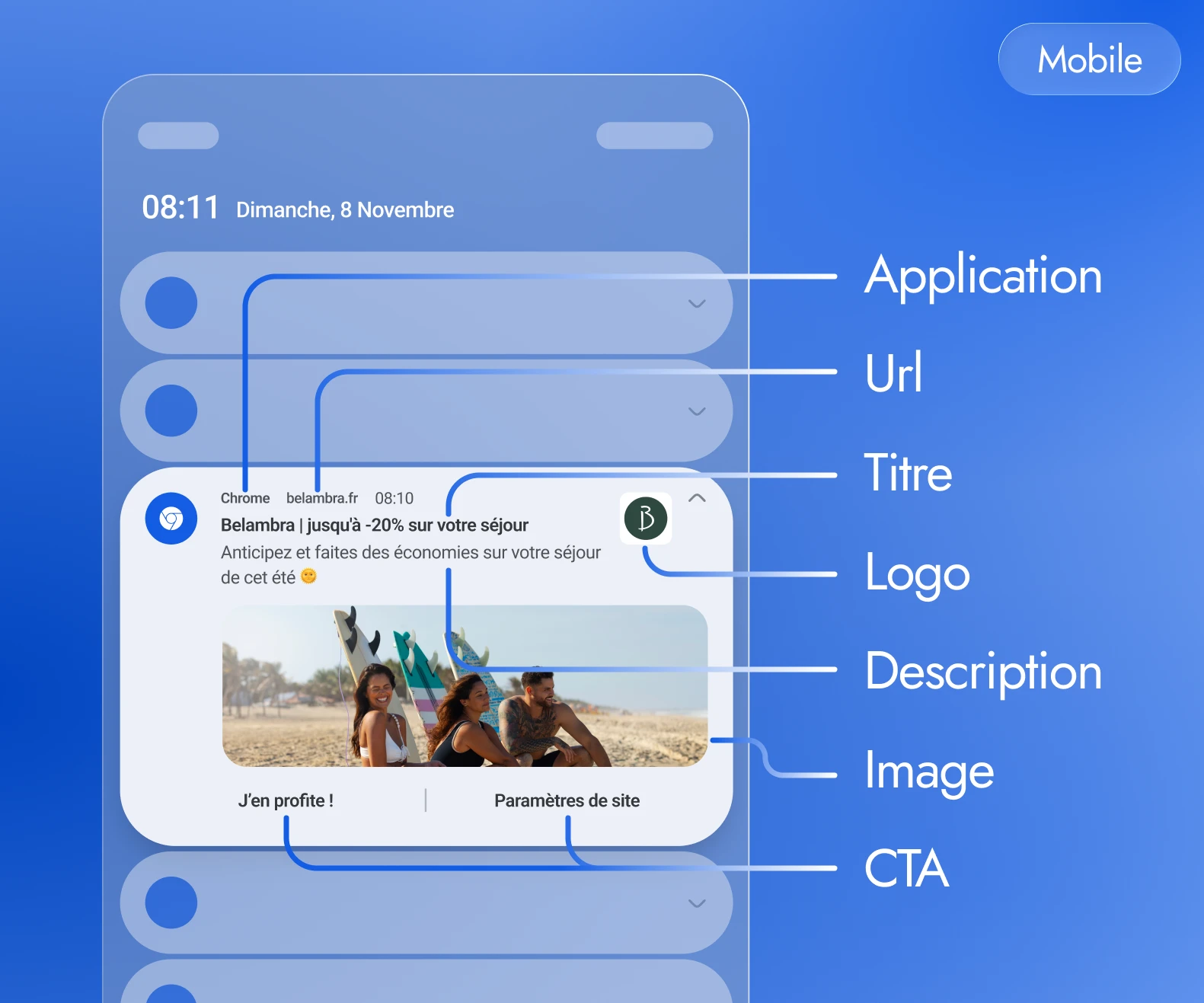
The problems that remarketing fixes
by Web Push Notification
| Common problem | What Web Push brings |
|---|---|
| Third-party cookies blocked or disappearing | Native browser identifier, without third-party cookies |
| Adblockers that block banners | System notification — not blocked by extensions |
| Emails ignored or filtered as spam | Immediate on-screen display, click rate up to 2× higher |
| Uncontrolled marketing pressure | Controlled frequency, one-click unsubscribe |
| Ad fraud | Direct user ↔ brand link, without opaque intermediary |
| GDPR non-compliance | Explicit browser consent (choice-first format) |
Adrenalead’s Web Push audience remarketing offer:
- An Internet user visits your site.
- He is recognized if he is part of the opt-in subscriber base of Adrenalead’s advertising network.
- They receive a notification presenting your offer.
- Each click redirects to the URL of your choice. Bonus: access to qualified audience segments (e.g. clickers from your campaign, visitors to your site who have subscribed to the network).
Why it’s a “new ROI Eldorado”? Adrenalead combines collection/sending technology with exclusive audience extension (network of over 60 million opt-ins). Results seen with e-retailers: reach x3 (up to +200% reach) vs. traditional methods, average CTR >4%, conversion rate >10%-with brand image preservation and compliance. → In plain English: 3× more chance of converting a qualified lead, with no third-party cookies, and a respectful, measurable experience.
Smarter, more responsible remarketing… and better performance
Remarketing in 2025 is no longer the simple banner that “follows everywhere”: it’s an omnichannel, data-driven, privacy-friendly orchestration boosted by AI. The end of third-party cookies is forcing a salutary mutation: first-party/zero-party data, contextual targeting, alternative IDs, opt-in channels. In this evolution, Web Push Notification – in particular the Adrenalead offering – is emerging as a performance gas pedal: real-time, RGPD-ready, brand safety, high engagement, independent of cookies and adblockers.
It’s up to you: apply the objective → segment → channel → message → measurement → iteration method, activate relevant scenarios, and pilot your budgets based on incremental results. You’ll be better able to turn your almost convinced “” visitors into customers – and your customers into followers.
Maximize my remarketing
with Web Push!
I want to test Web Push!
Frequently asked questions about remarketing
Remarketing vs retargeting: what’s the difference?
- Retargeting: primarily re-engages anonymous visitors via display/social channels, often historically cookie-based.
- Remarketing: covers all re-engagement channels, including email/SMS, Web Push, Customer Match, and more, relying more heavily on first-party data.
How can you make your first remarketing campaign successful?
- Set one clear objective.
- Segment your audiences.
- Choose 1–2 relevant channels, such as Google Display + Web Push.
- Set up tags/UTMs/Consent Mode.
- Create segment-specific messages and cap the frequency.
- Track CTR / Conv. / CPA and iterate weekly.
Which remarketing tools should you prioritize?
- Reach: Google Ads/YouTube, Meta.
- B2B: LinkedIn Ads.
- First-party activation: Customer Match & CRM onboarding.
- Real-time direct opt-in: Web Push, such as Adrenalead.
- Retention: Email/SMS + automation.
- Measurement: GA4 + attribution.
How can you use data to improve performance?
- Behavioral segments, such as pages, events, and recency; CRM segments, such as RFM, inactive users, and VIPs; and zero-party data, such as preferences.
- Use UTMs everywhere, and track ROAS/CPA + view-through when relevant.
- Identify the optimal frequency before saturation.
- Test competing offers, such as discount vs shipping.
- Activate AI for DCO/Smart Bidding.