Generating qualified leads is a critical challenge for automotive dealerships in the digital era. Today, 95% of car buyers start their journey online before visiting a dealership. Yet, 93% of new-vehicle sales are still finalized in-store (Google Gearshift study) — a clear sign that the phygital journey is now the norm. Given this reality, automotive marketing leaders must excel at turning online interest into dealership visits and qualified in-store leads.
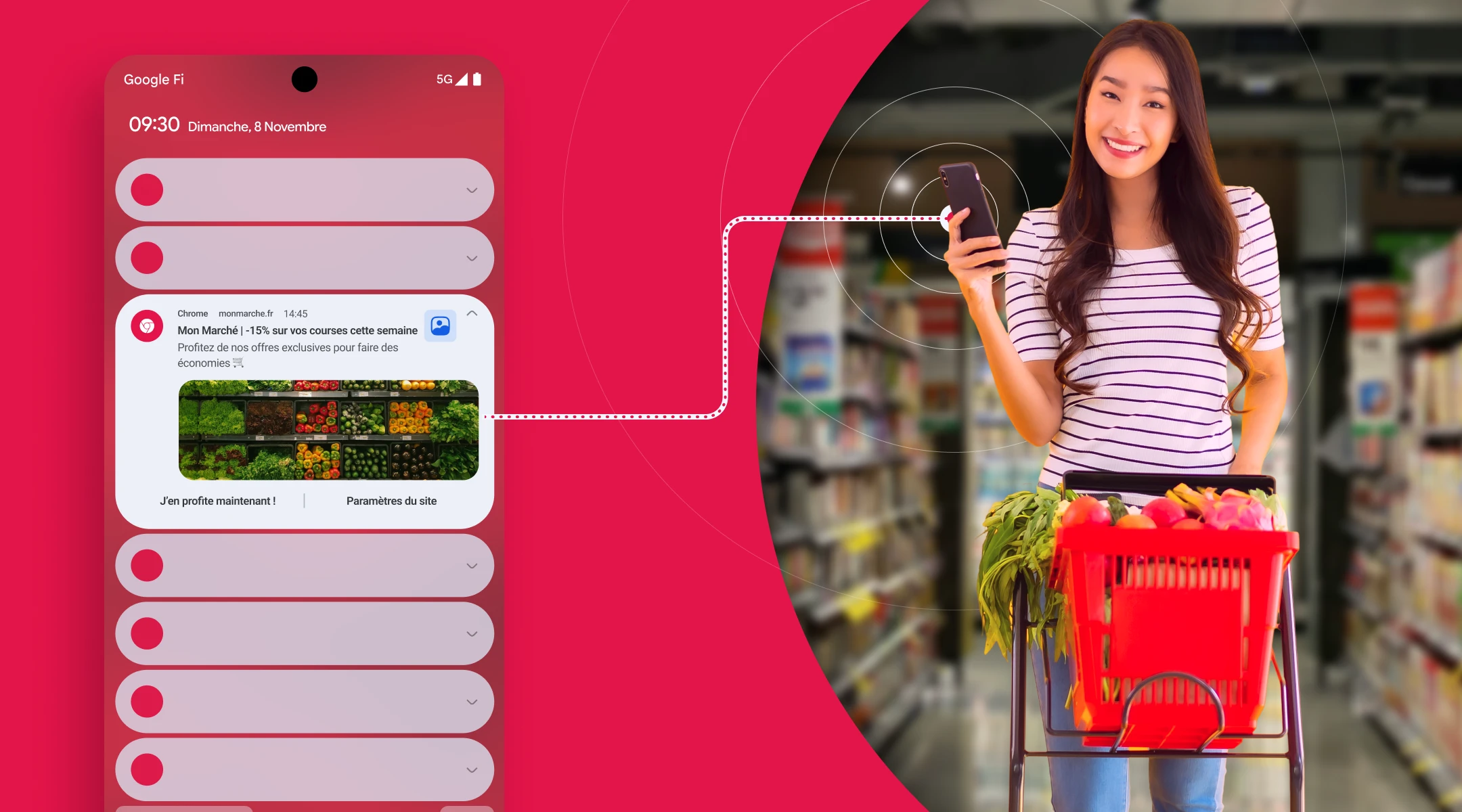
Experience shows that traditional channels (email, SMS, phone follow-ups) are hitting their limits: overcrowded inboxes, hard-to-reach prospects, rising media costs. This is where Web Push comes in — an unsaturated, highly reactive channel. By sending instant browser notifications (desktop or mobile), dealerships can reach users in real time, even after they’ve left the site — without relying on third-party cookies or fighting ad blockers. In other words, Web Push makes it possible to stay in touch with an anonymous visitor who didn’t share contact details, in a fully compliant way (explicit opt-in) and in a user-friendly format.
- Dealerships and automotive distributors: why should you consider Web Push for your campaigns?
- Promote open-house days and in-dealership events
- Re-engage online configurator visitors (hot leads)
- Recover abandoned “carts”: financing or service simulators
- Follow up after VN/VO vehicle page visits without conversion
- Deliver personalized offers based on the model viewed
- 2026: Web Push, a must-have lever for dealerships
Dealerships and automotive distributors: why should you consider Web Push for your campaigns?
The performance speaks for itself: the average click-through rate for a push notification reaches 4–8%, significantly higher than email (2–3%). Some ultra-personalized push campaigns even exceed 15–20% CTR — almost unheard of in digital marketing. In addition, after the announced (then canceled) end of third-party cookies and growing distrust of traditional retargeting, advertisers are shifting to first-party data strategies and prior consent.
Web Push fits this trend perfectly: users choose to subscribe, and messages are then delivered one-to-one, directly on their screen, with relevance and transparency.
It’s also important to highlight the track record of early adopters: well-executed Web Push campaigns have already proven their value with tangible results. For instance, security company Verisure reported +34% incremental leads generated over one quarter thanks to Web Push, with conversion rates aligned with their commercial targets.
In automotive, vehicle-related notifications (new models, service reminders, targeted promos) often achieve above-average open rates (10–15%) compared to other industries, proving that customers perceive real value. Backed by these learnings, sector expertise, and reliable data, Web Push is emerging as a must-activate lever to optimize dealership marketing ROI in 2026.
Let’s now dive into 5 practical use cases where Web Push excels at generating dealership leads, with quantified insights and the associated business benefits.
Promote open-house days and in-dealership events
Open-house days, VIP sales events, or local auto shows are key moments to drive foot traffic and capture leads (test-drive requests, quotes, etc.). Web Push enables dealerships to promote these events directly to interested users with a punchy, localized message. For example, a dealership can send a notification a few days before the event: “Open House this weekend! Be the first to discover our 2026 models and enjoy exclusive in-dealership offers.” This type of drive-to-store push combines urgency and hyper-local targeting: only subscribers in the area or those who showed interest in the brand receive the invitation, making the communication highly relevant.
Geo-targeting and drive-to-store impact
With specialized platforms, Web Push campaigns can be geo-targeted. A dealership network can, for example, send a notification only to subscribers located within X kilometers of each location. According to Adrenalead, Web Push makes it possible to activate drive-to-store promotional campaigns and digitize local communication for brick-and-mortar points of sale. In this scenario, each dealership promotes its open-house event with local details (location, dates, specific offer), maximizing relevance for the recipient.
The business benefits are clear: more qualified traffic on the day, and therefore more sales opportunities. While measuring offline impact precisely can be challenging without dedicated tooling, omnichannel attribution solutions are emerging to link in-store visits to a given push campaign. In the meantime, field feedback shows that event notifications often generate high click-through rates (above 5%) and higher in-dealership attendance on promotion days.
Even beyond open-house events, this practice strengthens a trust-based relationship with local prospects: by keeping them informed about dealership news, you stay top-of-mind throughout their buying process (authority and reliability).
Re-engage online configurator visitors (hot leads)
Most manufacturer or dealership sites offer an online configurator that lets users customize a vehicle and estimate a price. These users show strong intent (model selection, options…), yet many drop off before submitting a contact request. Web Push provides a powerful way to automatically re-engage these hot prospects as soon as they leave the configurator without converting.
For example, if a visitor configures a Peugeot 3008 and then closes the page, you can send a notification a few hours later: “Your Peugeot 3008 is waiting! Finish your configuration to receive a personalized offer at the dealership.” This proactive reminder can make the difference between a lost lead and a recovered prospect.
Automated retargeting scenario
Web Push best practices often involve building multi-step follow-up sequences when a user completes an incomplete action. For a vehicle configurator, for example:
- +15 minutes: send a first reminder push (“Finish configuring your vehicle to get an accurate in-dealership price 🚗💰”). While intent is still high, this targets users in active research mode.
- +24 hours: if they haven’t returned, send a second push with a stronger incentive — for example, a test-drive invitation or a limited-time offer (“Test-drive the 3008 this weekend: +€500 trade-in bonus”). This leverages exclusivity to trigger action.
- +3 days: a final push focused on service/advice, such as “Our advisors are here to help with your car project — contact us in 1 click”. Here, you avoid being overly salesy and offer help, so you don’t annoy the prospect.
This approach mirrors proven e-commerce methods: retargeting campaigns are 3× more likely to be clicked by already-interested users than by cold prospects. Similarly, in email marketing, abandoned-cart follow-ups can reach 18% conversion on average in automotive — evidence that well-timed reminders convert a meaningful share of hesitant prospects. Replicating this via instant push notifications (more visible than email, without waiting for users to check their inbox) drives strong engagement. “Retargeting” pushes typically show open rates 2–3× higher than generic cold sends. Each follow-up therefore increases the likelihood of turning intent into a qualified lead (quote request, appointment, etc.), directly improving digital ROI.
From a user-experience standpoint, if the sequence is well-paced (a few relevant messages, no spamming), prospects often appreciate the personalized attention. 50% of users who opt into push notifications are more likely to interact with the brand’s app or website. Applied to the web, this means a visitor gently re-engaged by push is more likely to return and complete the process rather than switching to a competitor. The E-E-A-T balance is respected: you react to their recent experience (an unfinished configurator), act as an expert on the customer need (advisor, tailored offer), demonstrate authority with concrete incentives, and build trust by guiding prospects without excessive intrusion.
Recover abandoned “carts”: financing or service simulators
Beyond the configurator, dealerships offer other online tools: financing simulators (loan, leasing/LOA), trade-in value calculators, service booking flows, etc. These are often long or multi-step forms that many users start and then abandon. Each abandonment is a potential lost lead (for example, a prospect interested in financing who never submits the request). Web Push notifications can dramatically reduce this leakage by acting as an instant “safety net”.
Imagine a prospect uses a leasing (LOA) simulator for a Renault Clio, then leaves before confirming. An effective strategy is to send a push such as: “🎁 Your financing offer is still available — enjoy a special rate for the Renault Clio you’re considering. Review your options before it expires.” Delivered shortly after abandonment, this message highlights the value left unfinished and encourages the prospect to return and finalize the request (FOMO, fear of missing out).
Recent industry data confirms the value of re-engaging hot prospects: for example, abandoned-cart recovery emails in automotive generate 18.6% conversion rates and an average of $9.86 revenue per email sent. In other words, each “reactivated” lead is extremely valuable. With Web Push, you can expect similar or even better results thanks to faster delivery and higher visibility. Plus, a push notification can be delivered even when the site is no longer open, unlike a banner or an email (which can go unnoticed for hours).
In practice, to keep this approach reliable, you should:
- Segment by abandoned form type: financing, trade-in, service appointment, etc., to personalize the push content (you don’t follow up a car loan quote the same way as a postponed oil change).
- Highlight a benefit or assistance: e.g., “Need help with financing? Our experts are here for you 📞” or “Trade-in estimate: get yours in 2 minutes — free!” This shows the dealership is reliable and service-oriented, not purely sales-driven.
- Limit the number of follow-ups: one immediate reminder and a second the next day are usually enough. No need to harass prospects and risk push unsubscriptions.
By recovering even a fraction of these abandoned forms, the dealership naturally increases its volume of qualified leads at a constant budget. This is automated lead nurturing that improves overall funnel efficiency. And for the customer, it’s a smooth experience: they’re re-engaged on something they initiated themselves, which feels like a service (not spam).
Follow up after VN/VO vehicle page visits without conversion
Many users browse new vehicles (VN) or used vehicles (VO) on a dealership website without taking the next step. They’ve shown interest in one or more models, but they don’t fill out a contact form or request a test drive. Rather than letting them leave anonymously, Web Push helps you maintain the connection and bring them back in another way. The idea: send a personalized notification after the visit to reignite attention around the model(s) viewed and suggest a logical next step.
For example, suppose a user spent 5 minutes on a used Toyota Yaris page, viewed photos, and left without contacting sales. The next day, you can send: “🔑 The 2019 Toyota Yaris you viewed is still available! Book a test drive before it’s gone.” This leverages stock freshness and the incentive not to miss out. For a new vehicle page view, adapt the message: “New Peugeot SUV: special offers available this month. Discover them at the dealership!” In both cases, you capitalize on expressed intent (specific model or vehicle segment) to propose a logical next step (test drive, special promo, new arrival).
This approach is similar to behavioral retargeting based on browsing signals — but without advertising cookies: everything is triggered on-site, with the prospect’s consent. According to Batch’s 2025 benchmark data, the “Mobility/Auto” category performs strongly on contextual push notifications, with up to 18.5% open rate on Android for well-targeted campaigns. This means notifications tied to recent user actions (e.g., viewing a vehicle) can drive notable interest — often higher than generic email blasts.
By re-engaging VN/VO vehicle page visitors, you can unlock several reliable business benefits:
- Increase lead conversion rate on online inventory: rather than relying on the ~2% of visitors who request info on their own, you proactively target the other interested users. Even if only a portion clicks (~5%), those are additional potential leads.
- Move specific vehicles faster: a push campaign can highlight offers on slow-moving stock. Example: “🔥 5 Citroën C3 available at discounted prices — reserve yours!” This creates urgency and drives dealership visits for those models.
- Improve the prospect experience: someone who spotted a car may appreciate a notification a few days later about similar arrivals or a price drop. Instead of revisiting the site to check, the info comes to them. This is a service that strengthens brand perception (expertise and personalized attention).
Of course, you must keep information accurate and trustworthy: if the vehicle sold in the meantime, adapt the message (“The 2019 Yaris has found its new owner, but similar models are waiting — take a look.”). The goal isn’t to mislead, but to maintain the conversation until the prospect finds the right vehicle with you rather than a competitor. In 2026, this kind of automated follow-up is becoming a quality standard: consumers expect responsive, relevant communication — otherwise, they quickly forget the first seller in a multi-dealership journey. Web Push provides that digital thread that can tip the scale.
Deliver personalized offers based on the model viewed
Last but not least, Web Push truly shines when it comes to delivering the right message to the right person, at the right time. In automotive, this means highly personalized offers based on the model or vehicle segment each prospect cares about. Instead of broadcasting “Come see our latest offers” to everyone, you can target by preference: promote SUVs to SUV shoppers, send service offers to owners of a given model, and so on. This granular personalization significantly increases the likelihood of converting the prospect into a lead, because the message resonates with their exact need.
For example, a visitor repeatedly checks pages about the New Renault Captur without taking action. The dealership can send: “🎁 Special Renault Captur offer: 0% financing + 3 years of free maintenance until month-end for online reservations. Don’t miss out!” Here, you use behavioral intent (interest in Captur) to craft a tailored, time-limited offer that creates a sense of unique opportunity.
This level of hyper-personalization isn’t a gimmick — it’s a strong expectation in 2026. According to a Localytics survey, 48% of users want special offers based on their preferences (e.g., browsing or purchase history), and 34% are open to offers based on their location. In other words, more than one in two customers will pay attention to a push that truly matches their needs. Conversely, generic notifications are likely to be ignored — or even trigger unsubscribes if they feel repetitive. In 2026, this expectation will only rise: “one notification = one message made for me” is becoming the standard. Automotive brands that adopt this approach early will gain a real competitive edge (authority and customer preference).
From a technical and data reliability standpoint, achieving this level of personalization sometimes requires pairing push with DCO (Dynamic Creative Optimization): partners like Adventori make it possible to personalize visuals and copy inside the notification, based on the nearest dealership’s inventory, for example. This unlocks highly creative, high-impact campaigns.
In terms of business value, personalized Web Push offers deliver:
- Higher engagement: personalized push campaigns can generate up to 4× more reactions than generic notifications. More clicks means more qualified traffic back to your site or dealership.
- More conversions: when prospects land on an offer they truly care about, they’re far more likely to act (book an appointment, request a quote). By analogy, in the app world, personalized product recommendation notifications can increase retention by up to 3× — a sign they keep users effectively moving through the journey.
- Better customer experience: prospects feel understood and valued. You demonstrate expertise by offering exactly what they’re looking for. This strengthens trust and brand image. A satisfied prospect will also be more likely to keep push enabled, since your messages consistently deliver value (a virtuous cycle).
Interest-based personalization makes your pushes far more ROI-efficient and reinforces your position as a trusted authority for prospects. That’s clearly the direction to take in 2026 to get the most out of this channel.
Dealerships that integrate these technologies (AI to analyze preferences, smart automation of campaigns) will be among tomorrow’s leaders in automotive digital marketing.
2026: Web Push, a must-have lever for dealerships
Over the past few years, Web Push has steadily become an essential digital marketing channel for automotive advertisers — and this trend will intensify in 2026. Web Push not only addresses today’s challenges (generating qualified in-dealership leads from web traffic, in a context where cookies are less central), it also benefits from upcoming technological and behavioral shifts. We can expect:
- AI-driven personalization to become the norm, enabling brands to deliver a unique message to every prospect based on profile, vehicle of interest, and real-time signals. In 2026, machine learning will be widely used to optimize delivery, content, and timing — maximizing user experience and conversion rates.
- Notification formats to evolve: “rich push” with images, short videos, interactive carousels, and more. In automotive, imagine a notification with a 360° view of a new model or a short teaser video sent during a launch. Rich content makes the notification even more compelling — like a mini ad spot on the customer’s screen — but without incremental media costs.
- More touchpoints: Web Push won’t be limited to the classic browser. With the growth of connected devices and wearables, some notifications will be read on smartwatches or other screens (vehicle dashboards someday?). Dealerships will need to adapt message style for these surfaces (very short, highly contextual). Either way, push will become ubiquitous within the omnichannel customer relationship.
Broader adoption across automotive players: still underused today, Web Push will likely be integrated by most automotive groups into their CRM strategy and advertising playbooks by 2026. Those who start now will build a head start in subscriber base and know-how (accumulated experience, authority on the topic). Like email 15 years ago, it will become a must-have — with less saturation as long as relevance best practices are maintained.
How can I quickly build a Web Push subscriber base on my dealership website?
Encourage users to opt in by clearly showing the value:
- Customize the permission prompt copy (e.g., via a welcome box): “Get exclusive offers and automotive news.”
- Ask at the right moment: trigger after several page views or after a vehicle page (a sign of intent).
- Welcome incentive (email-like) to accelerate opt-in.
- Explain the benefit: “Be the first to know about open-house days and local promotions.”
- GDPR transparency: users can unsubscribe via the browser; no personal data unless they explicitly share it.
Websites that clearly communicate the usefulness of push notifications typically see much higher opt-in rates.
What are the best practices for writing an effective automotive push notification?
Use the 3 A’s: Aligned, Alerting, Actionable.
- Aligned with context: e.g., based on the vehicle the user viewed.
- Alerting and concise (≈10 words): “48h Flash Deal: A/C service −30%” + 🚗/🔔 and a vehicle image to catch attention.
- Actionable: a clear CTA: “See offer”, “Book a test drive”, “Get a call back”.
Example: “🚗 Open House this weekend — test drives + exclusive offers. See you at the dealership!”
How do I measure the ROI of Web Push campaigns for my dealership?
- Push KPIs: delivery rate, display/open rate, click rate, then conversion (e.g., lead form submissions).
- ROI: compare incremental leads/sales to the platform cost (often fixed) — ROI can become positive quickly when push adds incremental results.
- Offline attribution: tracking options (privacy-safe geo measurement depending on the network) and in-dealership questions (“How did you hear about the event?”).
When executed well, Web Push complements other channels and can deliver meaningful incremental leads at a steady budget.