Today, Web Push has become a strategic lever for the hospitality industry to regain control over distribution in the face of OTAs (online travel agencies) and improve marketing performance. This channel lets you send instant messages to users who have opted in to push notifications via their web browser—without a mobile app.
For marketing directors, revenue managers, and digital leaders, Web Push delivers unmatched engagement rates (up to 90% opens vs. around 20% for email) and an ROI that can exceed 4,000% in hospitality.
Here’s an overview of the benefits of Web Push for the hotel sector—and how it helps you:
- Improve customer retention and drive cross-sell revenue
- Generate more direct bookings (as a complement or alternative to OTAs)
- Maximize occupancy (last-minute sales, yield management)
- Strengthen the guest relationship (pre-stay, in-stay, post-stay)
- Personalize offers based on behavior or seasonality
- Generate more direct bookings
- Maximize occupancy with instant offers
- Strengthen the guest relationship at every stage of the stay
- Personalize offers based on behavior and seasonality
- Improve customer retention and encourage cross-sell revenue
- Comparison: Web Push vs Email vs SMS vs OTA
- Hoteliers: Web Push integrates perfectly into your direct communication strategy alongside email and SMS!
Generate more direct bookings
Attracting guests directly is more critical than ever to reduce reliance on OTAs and protect margins. Web Push gives hotels an immediate retargeting channel to capture undecided visitors before they book elsewhere.
If a visitor abandons the booking flow on your hotel website, a well-timed push sequence can bring them back to complete the reservation: some travel platforms report that a series of Web Push messages can recover 45% to 52% of abandoned bookings. This “recovery” rate is significant and directly increases direct-booking volume.
Compared with email, Web Push wins on speed and visibility. Travelers visit an average of 38 websites before booking a hotel, and it’s easy to get lost among promotional emails. A push notification appears directly on the screen and captures attention instantly: 80% are read within the hour. The average click-through rate in the travel/hotel sector is 7% to 12% for a push notification, roughly triple the CTR of hotel marketing emails (3.5% to 4% in 2025). This higher engagement translates into more direct conversions: overall, push notifications generate a conversion rate of around 5% to 10%, versus 2% to 3% for emails. In other words, users who receive your offers via push are far more likely to book directly than through traditional email campaigns.
From a profitability standpoint, Web Push is a highly cost-effective channel. Once implemented, sending notifications is virtually free—unlike OTA commissions or even the per-message cost of SMS. A 2024 report calculated that direct distribution costs (including digital marketing) represented about 3.3% of booking revenue, well below the 15% to 25% commission charged by OTAs.
At scale, the impact is major: according to Skift, digital direct channels are expected to surpass OTAs by 2030 ($409B in direct bookings vs. $333B via OTAs).
Hotels that invest now in direct channels like Web Push are preparing for this shift and strengthening their commercial independence from intermediary platforms.
In practice, how does Web Push drive more direct sales?
As soon as a visitor opts in to notifications on your website, you gain a channel to reach them at any time. You can promote direct-booking-only offers (exclusive web promos, loyalty discount codes, free upgrades, etc.) to convince guests to book directly rather than through an OTA.
For example, while browsing your website, a visitor often compares multiple options; if they hesitate, a notification like “⭐ Book direct now and save 10%” can make the difference. Likewise, in the case of cart abandonment (an unfinished booking), a push message sent one hour later—reminding them the room is still available, possibly with a small incentive—can bring the guest back. That’s exactly what enables the 45% recovered conversions mentioned above. This ability to re-capture the guest at the right moment, before they book elsewhere, is a decisive competitive advantage for increasing direct sales.
Maximize occupancy with instant offers
For hotel revenue management, Web Push is a valuable ally to adjust occupancy in real time. When you have unsold rooms or a last-minute dip in occupancy, a well-targeted push notification can generate additional bookings almost instantly—where other channels may be too slow or too expensive.
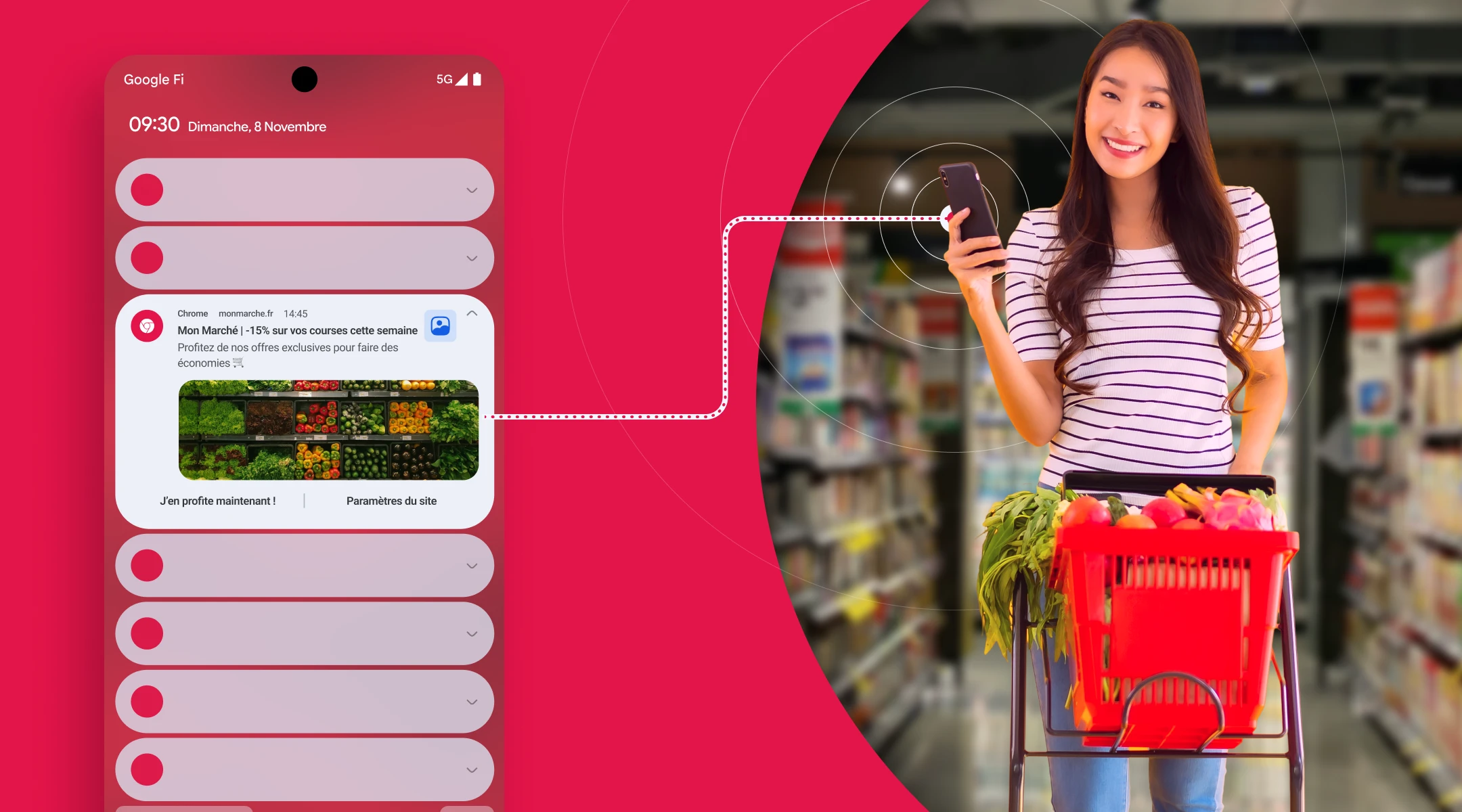
Example: A promotional push notification offering a flash deal to stimulate last-minute bookings in low season. This type of message, displayed instantly in the browser of opted-in guests, creates urgency and helps fill rooms that would otherwise remain vacant.
Push notifications are ultra-responsive: as noted, most recipients read them within minutes. So when needed, a hotel can launch, in just a few clicks, a targeted campaign like “Last rooms available tonight at -30%” to all subscribers who are geolocated nearby or who recently showed interest in a given property. Delivered in real time on mobile, this kind of flash offer can convince last-minute guests who would otherwise choose an OTA—or skip the stay altogether.
The speed of push outperforms email or social media for this type of urgent use case.
Web Push also supports yield management by helping you stimulate demand during slow periods
If your forecasts show low occupancy next weekend, you can schedule a few days ahead a special notification like “Last-minute getaway: weekend at -20%” reserved for subscribers.
This proactive lever can boost bookings without publicly discounting your rates, since the offer is only visible to your loyal audience. Conversely, in peak season or high-demand periods, you could send a notification like “Last availability: only 2 rooms left for New Year’s,” leveraging scarcity to prompt hesitant travelers to book now. Push notifications let you influence purchase behavior in real time in line with your yield strategy.
In short, Web Push gives hoteliers an unprecedented ability to manage occupancy in real time. You can act immediately on demand with relevant offers, when and where it matters—whether to sell unsold rooms or optimize ancillary revenue. Plus, these actions happen at near-zero marginal cost (no commission, no media spend), directly improving your RevPAR and GOP (operating profit).
It’s an agile tool that perfectly complements traditional yield strategies based on pricing and restrictions: here, you leverage ultra-targeted, real-time communication to drive immediate sales.
Strengthen the guest relationship at every stage of the stay
Beyond conversion, push notifications are a powerful relationship channel to support guests throughout their journey: before arrival, during the stay, and after departure. When used wisely, they enrich the experience and strengthen the bond between hotel and guest—boosting satisfaction and loyalty.
1. Before the stay (pre-stay)
The period between booking and arrival is ideal for engaging guests with personalized notifications, such as practical tips or special offers. These messages increase satisfaction, provide useful information, and help generate ancillary revenue before the stay (upgrades, restaurant reservations, massages, etc.). Push reminders also reduce no-show risk and make arrival smoother.
2. During the stay (in-stay)
Push notifications enable discreet, personalized, and automatable communication with guests—for example, guests who visited a page designed to identify them as an on-site guest during check-in, or the weekly activities page. Web Push can then be used to highlight a special offer (e.g., happy hour at the bar), promote services (e.g., an excursion available), or remind guests of practical information (e.g., check-out at noon). These messages enhance the guest experience and encourage engagement, with conversion rates reaching 51% for booking activities or restaurants during the stay.
3. After the stay (post-stay)
Post-stay communication marks the start of customer loyalty. With Web Push, you can maintain relevant, non-intrusive contact—for example, sending a thank-you message along with a review request, which increases response rates compared with traditional emails. These notifications support the collection of positive reviews and help re-engage guests with personalized offers, improving repeat-visit rates (+45% reported by some travel brands). They can also feed your loyalty program and share useful content, strengthening the relationship over the long term. When used well, Web Push enriches the guest experience and boosts satisfaction and loyalty.
Personalize offers based on behavior and seasonality
Personalization is essential in hotel marketing. Push notifications make it possible to deliver a targeted message in real time to each guest segment, based on preferences or behaviors (pages viewed, offer type, origin, geolocation, etc.). These messages can be triggered automatically after certain actions, such as booking abandonment or browsing specific pages or offers—bringing relevance and responsiveness without being intrusive.
Contextual push campaigns average a 14.4% open rate, compared with only 4.2% for generic push. Personalized notifications can even reach 55% to 75%, while promotional email typically gets only 15% to 25%.
So personalization—and choosing the right channel—makes all the difference.
Seasonality adaptation
Web Push makes it easier to plan targeted campaigns around seasons and events. By tailoring notifications to current guest needs and segmenting your audience, you increase relevance and performance—especially during peak moments like holidays or special events.
Content personalization
Push notifications allow you to personalize your message—for instance, by adding details tied to the guest experience using CRM data. This personalization increases interest and engagement: 80% of customers agree to share their preferences to receive more relevant offers. The short Web Push format makes efficient, relevant targeting easier.
Watch relevance
Push personalization must remain relevant and not overdone. Avoid over-messaging your subscribers and keep a healthy frequency. Well-targeted pushes can deliver strong conversion rates (around 15%), but poorly matched content can drive opt-outs.
Monitor your opt-out rate: above 2%, reduce frequency or refine targeting. Segment campaigns precisely and limit sends to ensure every notification delivers real value.
That’s how Web Push becomes an effective tool—appreciated by guests and profitable for hoteliers.
Improve customer retention and encourage cross-sell revenue
Acquiring a new customer is always more expensive than retaining an existing one. With that in mind, push notifications are a remarkably effective customer retention tool for hoteliers—complementing traditional loyalty programs.
They provide a direct way to stay in touch and bring past guests back to your website for a new booking at the right time. And because pushes enable targeted communications, they open smart cross-sell opportunities by offering add-on services or new destinations likely to match a guest’s interests.
A cost-effective, high-performing re-engagement channel
Re-engaging a guest with a push notification costs far less than acquiring a new user via Google Ads. Automated retargeting flows—such as reminders after 7 or 30 days (“We miss you! ❤️”)—can convert up to 22% of new customers and reactivate 12% of inactive users. Push-based nurturing helps recover a meaningful share of past visitors.
Boost repeat bookings (loyalty)
The main goal is to retain guests so they come back to your hotel rather than choosing competitors. Push notifications leverage guest satisfaction by offering personalized benefits, such as discounts or exclusive deals after the stay. They can also promote other properties in your group. These campaigns significantly increase repeat bookings, with some brands reporting up to a 45% uplift thanks to targeted actions.
Cross-selling services and offers
The guest relationship goes beyond the stay: push makes it easy to cross-sell services like the spa, restaurant, or partner offers to local past guests. This can generate visits without overnights—for example, through targeted notifications for day passes or profile-based promos (business, family). Personalization and segmentation maximize impact, with conversion rates far higher than email—up to 20% for “private sale” campaigns versus 2% to 3% for email.
Build a long-term community
Push notifications strengthen loyalty by turning guests into advocates (exclusive deals, VIP events, a perk with every stay). This encourages subscribers to prioritize your hotel and increases customer lifetime value. For example, a guest reactivated directly through personalized offers generates more revenue and reduces OTA costs; multiplied across multiple guests, ROI can reach 200% to 500%—not counting the positive effects on reputation and online reviews.
In summary, Web Push helps retain guests and maximize their value through re-engagement and cross-sell actions, while leveraging your database at low cost. In a highly competitive landscape for loyalty, this tool gives hotels an effective, cost-efficient CRM solution that drives retention and incremental revenue.
Comparison: Web Push vs Email vs SMS vs OTA
| Criteria | Web Push (Browser notifications) |
Email Marketing (Newsletters) |
SMS Marketing (Text messages) |
OTAs / Platforms (Booking, Expedia…) |
|---|---|---|---|---|
| Channel type | Owned media: direct to the guest (via your website). Opt-in required. | Owned media: customer/prospect base (email form). Opt-in required. | Owned media: direct on mobile (customer phone numbers). Opt-in required. | Paid media: paid third-party channel (external distribution). |
| Reach / Audience | Medium: typically 10% to 15% of visitors subscribe (qualified audience). | Low to medium: newsletter subscribers or customers (often 2% to 5% of visitors). | Low: numbers collected at booking (existing/local customers). | Very broad: global platform audience (mixed prospects). |
| Open rate | 40% to 60% on average (up to 90% on mobile). | ≈ 20% on average (17% to 28% in hospitality). | 98% (nearly all SMS are read). | N/A (guests see the offer when searching on the OTA). |
| Click / action rate | 7% to 15% on average (can reach 30% if highly targeted). | 3% to 5% on average (higher with targeted offers). | ≈ 5% to 20% (highly variable; on the high end, ~50% of clicks lead to a purchase). | 2% to 4%: average conversion rate from OTA visits to booking (platform-dependent). |
| Time-to-attention | Instant: real-time notification on screen. | Variable: inbox checked a few times/day. | Instant: near-immediate reading. | Intermediate: guests see the OTA offer when using the site/app. |
| Cost for the hotel | Very low: free sends (push platform subscription). | Very low: email tools are inexpensive (often flat-rate). | Medium: ~€0.05/SMS on average + opt-out management. | High: commission 15% to 25% per booking (contract-dependent). |
| Personalization | High: behavior targeting, triggers, short personalized copy. | High: CRM flows, rich content. | Limited: < 160 characters, little context. | Low: standardized listing, personalization controlled by the OTA. |
| Best use cases | Fast retargeting, flash promos, cart abandonment, stay information. | Loyalty with personalized content, scheduled promos, confirmations. | Urgent alerts (access codes, schedule changes), very limited offers. | New customer acquisition (visibility), additional volume (high cost). |
Hoteliers: Web Push integrates perfectly into your direct communication strategy alongside email and SMS!
While it doesn’t necessarily replace them, Web Push adds an extra capability for short, instant messages—with remarkable effectiveness. Unlike OTAs, these direct channels (push, email, SMS) preserve your independence and your guest relationship.
The best strategy today is to orchestrate these levers intelligently—for example, using email for monthly newsletters and long-form content, push for flash alerts and real-time conversation, SMS for emergencies or critical confirmations—while still benefiting from OTAs to acquire new guests then converting them into direct customers through these owned-media channels. The table above helps you identify each channel’s role so you can build an optimal communication mix.