Your policyholder trusted you on the day they signed. They called you back at the time of a claim. And in between? Radio silence — until the annual renewal date, that fateful moment when they compare your rates on a comparison site in three clicks. Insurance suffers from a persistent paradox: it is a sector built on trust, yet a relationship that barely exists on a day-to-day basis. Web Push is not a miracle solution. It is simply the missing link between your contract and your customer’s life.
- The real challenges facing an insurance communications manager
- Web Push and insurance: the right channel for the right moments
- 4 concrete use cases for an insurer
- "Yes, but…": objections from the insurance sector
- Adrenalead, the partner of choice for insurance players
- In conclusion: your policyholder base is a dormant asset — it's time to activate it
The real challenges facing an insurance communications manager
Before talking technology, let’s talk reality. If you manage digital communications for an insurer — whether a general insurer, mutual, broker or insurtech — here is probably what keeps you busy on a daily basis.
The “drawer contract” syndrome
This is the sector’s endemic problem. The policyholder signs up, receives their documents by email or post, files them away somewhere — digital or physical — and doesn’t think about them again until the next incident. Your product is useful, certainly; but your relationship, on the other hand, is virtually non-existent. Into this relational vacuum pour impulsive cancellations, underinsurance and missed upsell opportunities.
A highly seasonal customer relationship
The activity peaks are well known: January for supplementary health cover, spring for motor insurance, the back-to-school period for school and home contracts. The rest of the time, your communications teams juggle with flagging email open rates and social campaigns lost in the noise. The customer relationship in insurance is structurally discontinuous — and that is precisely where everything is decided.
Cancellation: a permanent risk in the era of easier switching
Legislative changes in several markets have profoundly altered the balance of the policyholder/insurer relationship, enabling cancellation at any time after an initial period, with no fees and no justification required. In this context, every silence on your part is an opportunity for a competitor. Maintaining a useful and regular link with your policyholders is no longer a comfort option — it is a retention necessity.
Upsell and cross-selling: the untapped potential
Your existing client base is often your best source of growth. A motor insurance customer who doesn’t know you offer a competitive home insurance policy. A home insurance customer who is unaware of your income protection offer. Cross-selling in insurance is a massive lever — provided you have a channel to activate it at the right moment, with the right message. That channel is not email, where communication pressure is already at its maximum on your databases.
The comparison site battle
Before your customer even thinks about contacting you, they have already opened lesfurets, a price comparison platform or a specialist aggregator. These platforms capture purchase intent upstream, with advertising budgets that few insurers can individually match. The answer is not necessarily to outbid on these acquisition channels — it is to create a direct, personalised and continuous relationship that makes automatic price comparison less reflexive.
Web Push and insurance: the right channel for the right moments
A quick overview of the format for those who are new to it, before diving into the insurance specifics.
The mechanism in 30 seconds
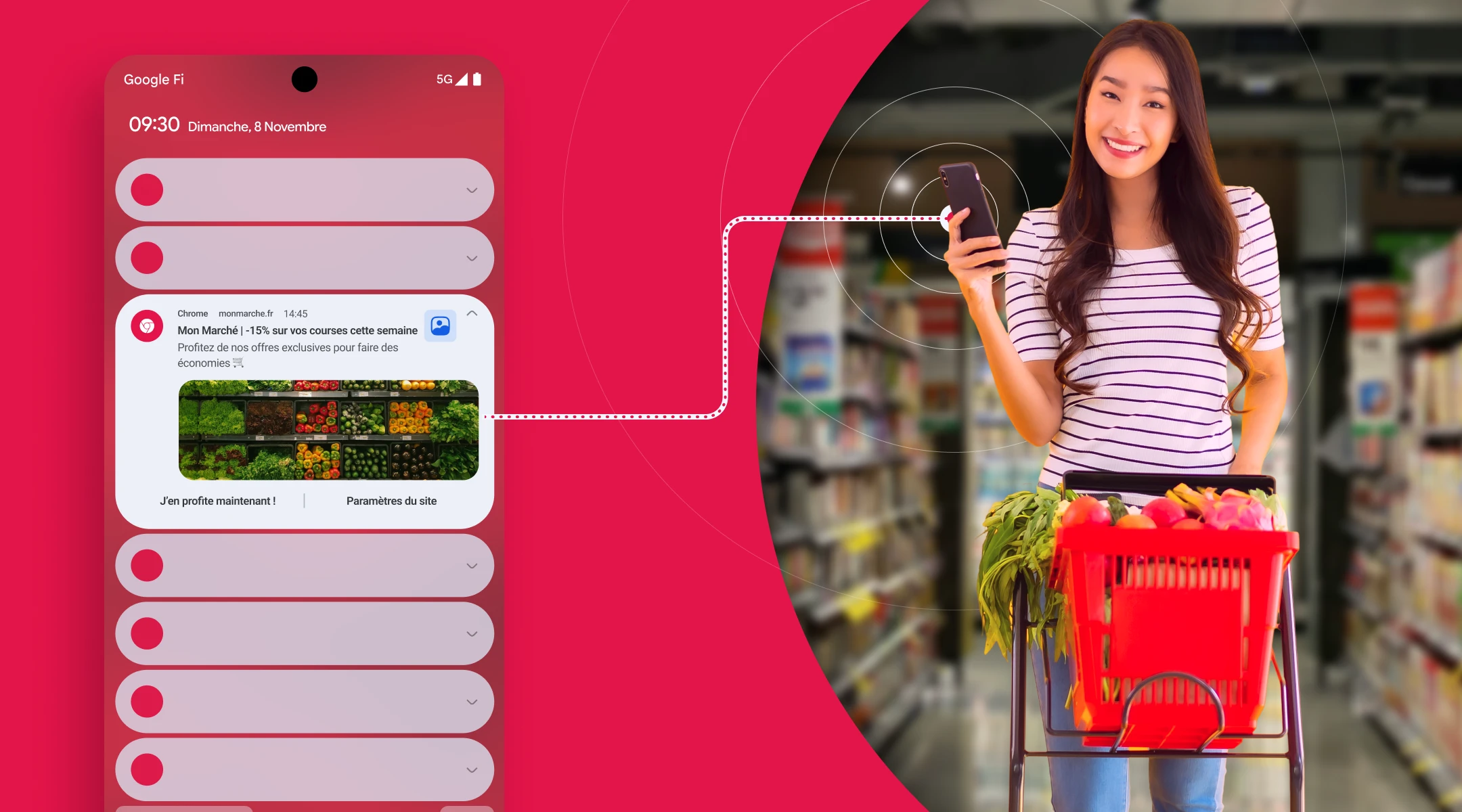
A Push Notification is a clickable message sent directly to a user’s screen — desktop or mobile — from their browser, after they have given their explicit consent by clicking “Allow” during a visit to your site. No app to download, no email address collected, no phone number. A Service Worker registers on the browser side and maintains the connection, even when your site is closed.
What changes in the insurance context
In insurance, the concept of moments of truth is central. There are few of them (subscription, claim, renewal), but they are decisive for the relationship. Web Push is precisely designed to intervene between these moments, with useful, contextual and non-intrusive messages. It does not replace your customer portal, your app or your email: it creates a presence where you were previously absent.
And because the policyholder is a customer with a long lifecycle — sometimes years on the same contract — the value of a Web Push subscriber base compounds over time. Each new subscriber is a potential contact thread for all future interactions.
4 concrete use cases for an insurer
Here is how Web Push translates into the day-to-day reality of an insurance communications strategy. These scenarios are directly activatable, whatever your scope — motor, health, home, income protection or multi-risk.
Case #1, Contextual upsell: the right offer at the right life moment
This is where Web Push reveals its full subtlety. Unlike email, which follows an editorial calendar, Web Push can be triggered by external context. A few telling examples:
- First cold snap forecast → notification to your home insurance policyholders: “Protect your pipes this winter — discover our enhanced water damage cover”
- Eve of a long weekend or school holiday → notification to your motor policyholders without breakdown cover: “Travel with peace of mind — add roadside assistance to your policy in 2 minutes”
- Tax return season → notification to your income protection clients: “Optimise your tax position with our pension contract — simulate your saving”
The principle is simple: you don’t interrupt your customer with a generic offer — you provide a relevant response at the moment when the context makes it feel natural.
Case #2, Proactive prevention: the added value that builds loyalty
Preventive insurance is an increasingly powerful differentiator, and Web Push is the ideal channel to embody it on a daily basis. A few directly usable ideas:
- Localised weather alert (storm, frost, heatwave) → prevention tips tailored to the type of contract
- Reminder for the mandatory MOT for motor insurance policyholders
- Seasonal home tips: checking smoke detectors, winterising the garden, securing the property before an extended absence
These messages don’t sell anything directly. They do something more valuable: they establish the image of a partner insurer — present, useful and engaged — which is exactly the positioning every insurer strives to embody in their institutional campaigns.
Case #3, Targeted product launch by profile
You’re launching a new supplementary health offer aimed at seniors? A cyber-risk cover for professionals? A retirement savings product for the 40–55 age group? Web Push allows you to target your notifications based on the profile of your subscribers, their existing contracts or their behaviour on your site. You don’t send a notification to everyone — you send the right notification to the right profiles, which maximises perceived relevance and minimises unsubscribes.
Case #4, Referral campaign targeting satisfied policyholders
Referral is one of the most cost-effective acquisition levers in insurance, as it is built on the transitive trust between a policyholder and their network. Web Push is a natural channel for activating these campaigns: a targeted message to your most engaged policyholders (those who have claimed least, the longest-standing, those who hold multiple products) with a simple mechanic and a direct link to the referral form.
“Yes, but…”: objections from the insurance sector
Insurance is a sector that is cautious by culture and by obligation. Internal objections are often legitimate and deserve precise answers — not marketing pirouettes.
“Our customers don’t want to be disturbed”
This is a legitimate concern, and it points to the real question: the relevance of the message, not the channel itself. A policyholder who receives a useful weather alert before a storm is not being “disturbed” — they are being looked after. Web Push allows fine-grained control over send frequency and content. And if a subscriber no longer wishes to receive notifications, they can unsubscribe in a few clicks from their browser — infinitely simpler than unsubscribing from an email list.
“We have strict regulatory information obligations”
Absolutely — and Web Push is not intended to replace them. Legal information obligations (renewal notices, general conditions, policy statements) must go through official, archivable channels: post, email with delivery confirmation, customer portal. Web Push intervenes as a complement, as an attention signal and redirect to these official documents. It replaces nothing — it amplifies.
“Our DPO will block this”
This is the most common objection in regulated sectors — and the least founded when it comes to this specific channel. Web Push is one of the rare marketing formats whose consent is managed natively by the browser itself, without any intervention from your site. No health data, no policy number, no sensitive information passes through the notification mechanism. Consent is explicit, time-stamped and revocable. It is structurally one of the most GDPR-compliant channels in existence.
“We already have a customer portal and a mobile app”
Excellent. How many of your policyholders log in spontaneously more than once a year? The answer is often disappointing. Your customer portal and app are pull channels — they wait for the customer to come to them. Web Push is a push channel — it goes to the customer, where they are, at the moment you choose to reach out. The two are complementary: the notification drives the traffic, the customer portal handles the relational depth.
Adrenalead, the partner of choice for insurance players
Since 2018, we have been pioneers of Web Push in France and Europe. Our platform is now adopted by more than 2,000 companies, and our network covers more than 60 million opt-in profiles — making it the leading Web Push network on the open web at this scale.
Integration in 10 minutes, with no technical dependency
A JavaScript script, a Service Worker at the root of your domain, and you are up and running. For WordPress, Shopify or PrestaShop websites, a dedicated plugin simplifies the setup even further. No overhaul, no lengthy IT project, no dependency on your IT department for each send.
Affinity targeting for relevant campaigns
Our platform allows you to segment your audiences based on their behaviour on your site (pages visited, products viewed, forms abandoned), their device type, their location or their engagement history. For an insurer, this translates concretely: you don’t send the same notification to a first-time 25-year-old policyholder and a 55-year-old multi-product holder.
A dedicated CSM, based in France
Every Adrenalead client benefits from a Customer Success Manager based in France, available to help you define your communication scenarios, optimise your opt-in rates, calibrate send pressure and interpret your performance data. No documentation to wade through alone: human expertise, accessible when you need it.
Access to the audiences of major media outlets
If your objective is to go beyond your existing base and reach qualified new prospects via Web Push, our ad network connects you to the audiences of major media such as Doctissimo, aufeminin, Cosmopolitan, Auto Plus, Pleine Vie and Top Santé. You gain access to affinity audiences targetable by socio-demographic profile, interest or browsing behaviour, with full control over the quality of the campaigns delivered.
In conclusion: your policyholder base is a dormant asset — it’s time to activate it
Insurance has a rare characteristic in the digital world: a captive, identified client base that has already extended its trust. The problem is not a lack of data — it is a lack of channels to activate it intelligently throughout the year.
Web Push is not a trend — it is a mature, GDPR-compatible technology, already deployed by the most agile players in the sector. Insurers who integrate it today are building an opt-in subscriber base that appreciates in value with each new policy taken out, each renewal, each life event of their customers.
Those who wait will watch their competitors — and the insurtechs — deploy it in their place.
Would you like to evaluate the potential of Web Push for your client portfolio? Request a personalised demonstration from our team.