A dangerous product recall. A banking outage during peak hours. A national health alert. These situations share one thing in common: every minute lost worsens the consequences. And yet, the usual communication channels are not designed for urgency.
Email is read on average 3 to 4 hours after sending. SMS is effective but expensive at scale. Mobile apps require a prior download. Social media depends on algorithms and unpredictable visibility rates.
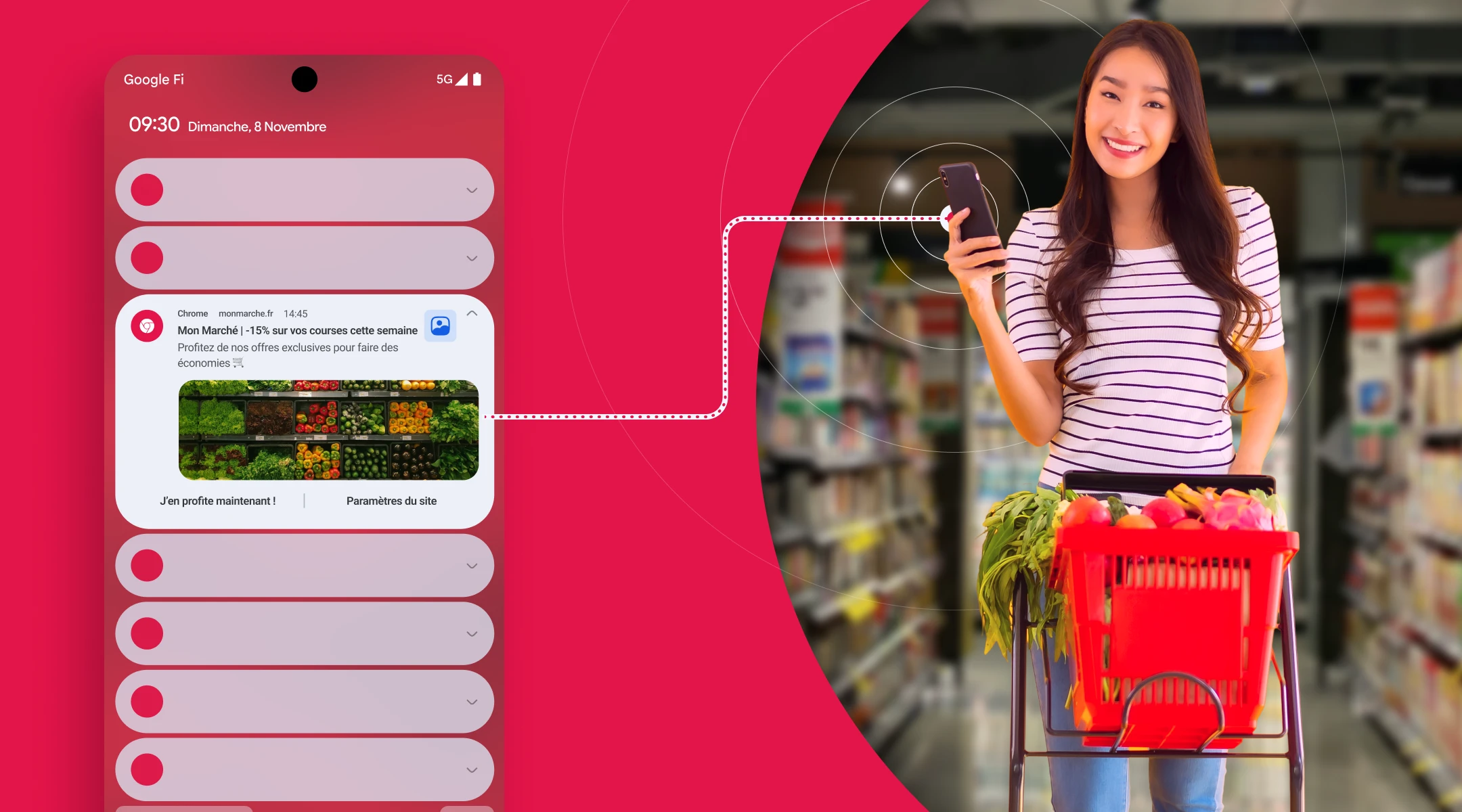
A Web Push is structurally different: it appears in real time on the recipient’s screen, with no email, no app, no intermediary. It works on desktop and mobile, including on a locked screen. For sensitive communications and crisis situations, it is one of the most reliable channels available today.
Here are 5 concrete use cases, from e-commerce brands to public institutions, including banks and service providers.
- What Web Push changes in emergency communication
- Use case 1: product recall by a food retailer
- Use case 2: technical incident at a bank or financial service
- Use case 3: operational disruption in transport or events
- Use case 4: health or regulatory alert
- Use case 5: national alerts via the Adrenalead publisher network
- Best practices for sensitive communications
- What Web Push does not replace
- Web Push Notification is not just a marketing tool.
What Web Push changes in emergency communication
Absolute instantaneity. A sent notification is displayed within seconds on the recipient’s screen, whether or not they are actively using their device. Unlike email, there is no delay linked to syncing, inbox checking, or spam filters.
Coverage without an app. Subscribing to Web Push takes one click from the browser. No app to download, no account to create. The entry barrier is nearly non-existent, which allows for building large and representative subscriber bases.
Priority display. On desktop and mobile operating systems, push notifications appear layered over all other windows and apps, even in sleep mode. They cannot be missed the way an email can get buried in a full inbox.
Native GDPR compliance. Consent is explicit, documented by the browser, and revocable at any time. No personal data is transmitted during opt-in. For institutional or regulatory communications, this point is fundamental.
Real-time measurability. Delivery rate, open rate, click-through rate: performance indicators are available in real time, allowing you to assess the reach of an alert and adjust the message if needed.
Use case 1: product recall by a food retailer
⚠️ Urgency level: high | Sector: retail, food, cosmetics, pharmacy
A product is recalled for a safety defect, contamination, or regulatory non-compliance. The retailer has a few hours to warn as many affected consumers as possible and prevent the risk from worsening.
Email alone is insufficient: 75% of recipients won’t read the message the same day. Social media only reaches a fraction of customers, depending on distribution algorithms. Web Push, on the other hand, reaches the entire opt-in subscriber base within seconds, including those who haven’t checked their email that day.
The scenario
As soon as the recall is confirmed, a notification is sent to the site’s entire subscriber base. The message is short, factual, with a link to the official recall page on the retailer’s website.
⚠️ Product recall: action required
Product [Name] (batch no. XXX) is subject to a recall. Please do not consume it.
→ View official information
Why it works
- Immediate distribution to the entire subscriber base, with no filter or delay
- Doesn’t require the customer to be logged into their personal account
- Can be targeted by geographic area or by product viewed, if the data allows it
- Complementary to email: both channels together maximise coverage
Use case 2: technical incident at a bank or financial service
⚠️ Urgency level: high | Sector: banking, insurance, fintech
An outage hits the mobile app or online banking site during peak hours. Customers can no longer access their accounts, make transfers, or pay by card. Within minutes, social media lights up. Customer service is flooded with calls.
In this context, proactive communication is the best response. An institution that informs its customers before they discover the outage themselves preserves its relationship of trust and mechanically reduces pressure on its support teams.
The scenario
As soon as the incident is confirmed, a first notification is sent to inform customers of the outage and reassure them that it’s being handled. A second is sent once resolved, to confirm the return to normal.
🔧 Ongoing incident on our services
Our app is experiencing technical difficulties. Our teams are on it. We’ll keep you informed.
→ Follow progress
✅ Our services are back up
The incident is resolved. You can access your customer account normally again.
→ Log in
Why it works
- Reverses the timing: the customer is informed before experiencing the frustration of discovering the issue themselves
- Significantly reduces incoming calls to customer service
- Builds trust: transparency in incident management is a strong differentiator
- The resolution notification closes the loop and confirms the return to normal
Use case 3: operational disruption in transport or events
⚡ Urgency level: medium to high | Sector: transport, events, public services
A delayed train, a cancelled flight, a postponed event, or a schedule change: in all these cases, the traveller or attendee needs to be informed as early as possible to make the right decisions (rebooking, alternative route, preparation).
Web Push is particularly well suited to these use cases because it can be targeted geographically and by browsing behaviour. Subscribers who viewed pages related to a specific destination, date, or event can be notified differently.
The scenario
🚆 Disruption on the London-Manchester line
Delays are expected this evening between 6pm and 9pm due to a technical incident.
→ See alternatives
Why it works
- Targeted distribution by geographic area or destination viewed
- Reduces the influx of travellers at stations or ticket counters
- Allows immediately offering alternative solutions via the notification link
- Works even if the operator’s app isn’t installed
Use case 4: health or regulatory alert
⚠️ Urgency level: high | Sector: health, pharmacy, insurance, mutual funds
A pharmacovigilance alert, an urgent regulatory change, an update to reimbursement conditions, or a health recommendation: these communications require reaching the people concerned quickly and tracking distribution.
In the health and insurance sector, communication compliance is as important as its speed. Web Push, based on explicit and documented consent, offers full traceability of sends and reads.
The scenario
🏥 Important information about your reimbursement
Coverage terms for remote consultations are changing from 1 July.
→ Learn more
Why it works
- Documented, traceable consent, compliant with the sector’s regulatory requirements
- Instant distribution, with no risk of delay linked to email filters
- Complementary to mandatory postal communications for the most connected audiences
- Allows precise tracking of the information’s acknowledgement rate
Use case 5: national alerts via the Adrenalead publisher network
🇬🇧 Urgency level: critical | Scope: national | Reach: 60M opt-ins
Some situations go beyond the scope of a single brand or sector: a national alert linked to a health, climate, environmental, or security risk. In these cases, distribution capacity is the limiting factor.
Adrenalead relies on a network of more than 1,500 partner publishers and 60 million opt-in subscribers in France. This network represents a massive distribution infrastructure, capable of relaying a national alert within minutes, across millions of screens simultaneously.
Concretely, Adrenalead can make this network available to public authorities to distribute a critical alert across all partner sites, reaching a large and representative population without requiring a dedicated app or prior citizen registration. The existing opt-in on each partner site is enough.
What this enables
- Simultaneous distribution to 60 million opt-ins via 1,500+ partner sites in France
- Activation within minutes from the Adrenalead platform
- Geographic targeting possible (region, department) for localised alerts
- No app to install: the browser is enough, on desktop and mobile
- Full distribution traceability: number of notifications sent, delivered, and seen
🚨 Official alert Police Authority
Stay indoors until further notice. Avoid the [area] zone. Information at gov.uk.
→ View official instructions
This type of system positions Web Push no longer as a simple marketing tool, but as a public-interest communication infrastructure, quickly mobilisable alongside existing official channels (emergency alert systems, public media, social networks).
Best practices for sensitive communications
Tone: factual, short, without excessive alarmism
Effective crisis communication is precise and unambiguous. It clearly states the nature of the problem, what the user should do (or not do), and where to find more information. It avoids alarmist phrasing that can generate panic, and vague phrasing that doesn’t allow action to be taken.
- Name the problem clearly (“technical incident”, “product recall”, “health alert”)
- Give a concrete action (“do not consume”, “stay indoors”, “follow progress”)
- Point to an official source for details
- Avoid superlatives and unnecessary anxiety-inducing phrasing
Format: short title, action message, direct link
The Web Push format is constrained: 50 characters for the title, 120 characters for the body. This constraint is actually an advantage for emergency communication: it forces conciseness and focus on the essentials. No length, no elaboration: just the critical information and the associated action.
Frequency: don’t dilute urgency
The effectiveness of an alert also relies on its rarity. A channel overused for promotional communications loses credibility the day it’s needed for a real emergency.
The rule is simple: reserve the “urgent” register for what is genuinely urgent. To go further on this topic, our article on managing marketing pressure details how to maintain a channel’s value over time.
Follow-up: closing the loop
Crisis communication without resolution leaves recipients uncertain. As soon as the situation is resolved or under control, a closing notification is essential: it confirms the return to normal, closes the cycle, and reinforces trust in the channel for future communications.
What Web Push does not replace
Web Push is a powerful channel for emergency communication, but it has limitations that need to be factored into any crisis management strategy.
- It only reaches opt-in subscribers. A person who hasn’t accepted notifications on your site cannot be reached. Hence the importance of building your subscriber base in advance, before there’s an emergency.
- It requires an internet connection. Unlike SMS or phone calls, Web Push doesn’t work offline. For alerts that need to reach low-connectivity areas, other channels are necessary.
- It does not replace official government channels. Emergency alert systems, sirens, and public media remain the reference channels for government alerts. Web Push comes as a complement, to speed up and broaden distribution.
- It does not substitute for detailed communication. The notification’s short format pushes toward the essentials. For situations requiring lengthy explanations (procedures, recourse, technical details), a link to a dedicated page is essential.
Web Push Notification is not just a marketing tool.
In situations that demand speed, coverage, and reliability, push notification technology is one of the most effective channels available. Its structural characteristics — instantaneity, priority display, documented consent, no-app operation — make it a tool of choice for sensitive communications.
The 5 use cases presented here illustrate the breadth of scope: from a retail brand’s product recall to the distribution of national alerts via Adrenalead’s 60-million opt-in network. In all cases, the principle is the same: inform quickly, inform clearly, and close the loop as soon as the situation is resolved.
The essential condition remains building a subscriber base in advance. A notification infrastructure only has value if it’s built before the emergency. It is the most strategic investment an organisation can make today.