The marketing automation market is worth $6.1 billion in 2026, with a projected annual growth rate of 13.7% through 2030. These figures mask a deeper reality: it isn’t the volume of tools that’s exploding, it’s their ability to decide on their own, to personalise in real time, to operate on channels that marketing teams weren’t even managing three years ago.
For marketing leaders, e-commerce directors and growth teams, the next four years represent a fork in the road. Brands that anticipate these developments will gain a structural head start over those that wait. Those that underestimate the pace of change will find their stacks and methods obsolete before they’re even fully deployed.
This article reviews the six major trends set to reshape marketing automation through 2030, with a particular focus on Web Push Notification: an underused channel today, but one that occupies a strategic position at the convergence of all these developments.
- Real-time hyper-personalisation: from segment to individual
- AI as a decision-making engine, not just execution
- Cross-channel orchestration: towards the single platform
- First-party data: Web Push as a natively compliant channel
- Loyalty and retention automation: the full lifecycle
- New surfaces: beyond the desktop browser
- What these trends mean concretely for your strategy today
- Marketing automation in 2030 will be unrecognisable compared to 2020 practices
Real-time hyper-personalisation: from segment to individual
For years, “personalisation” in marketing meant splitting a database into ten groups and slightly adapting content per group. In 2026, this approach is already outdated for the most advanced players. By 2030, it will be the bare minimum for everyone.
Real-time hyper-personalisation rests on a simple principle: every message sent to a user is unique, dynamically built from their recent behaviour, their context (time, location, device) and their position in the customer lifecycle. It’s no longer a human defining personalisation rules — it’s a model generating and continuously adjusting them.
The operational consequences are significant. Marketing teams will no longer create campaigns — they’ll define constraints (editorial line, permitted offers, maximum frequency) and let automation operate within these guardrails. The marketer’s role shifts from message designer to systems architect.
Web Push’s role in this paradigm
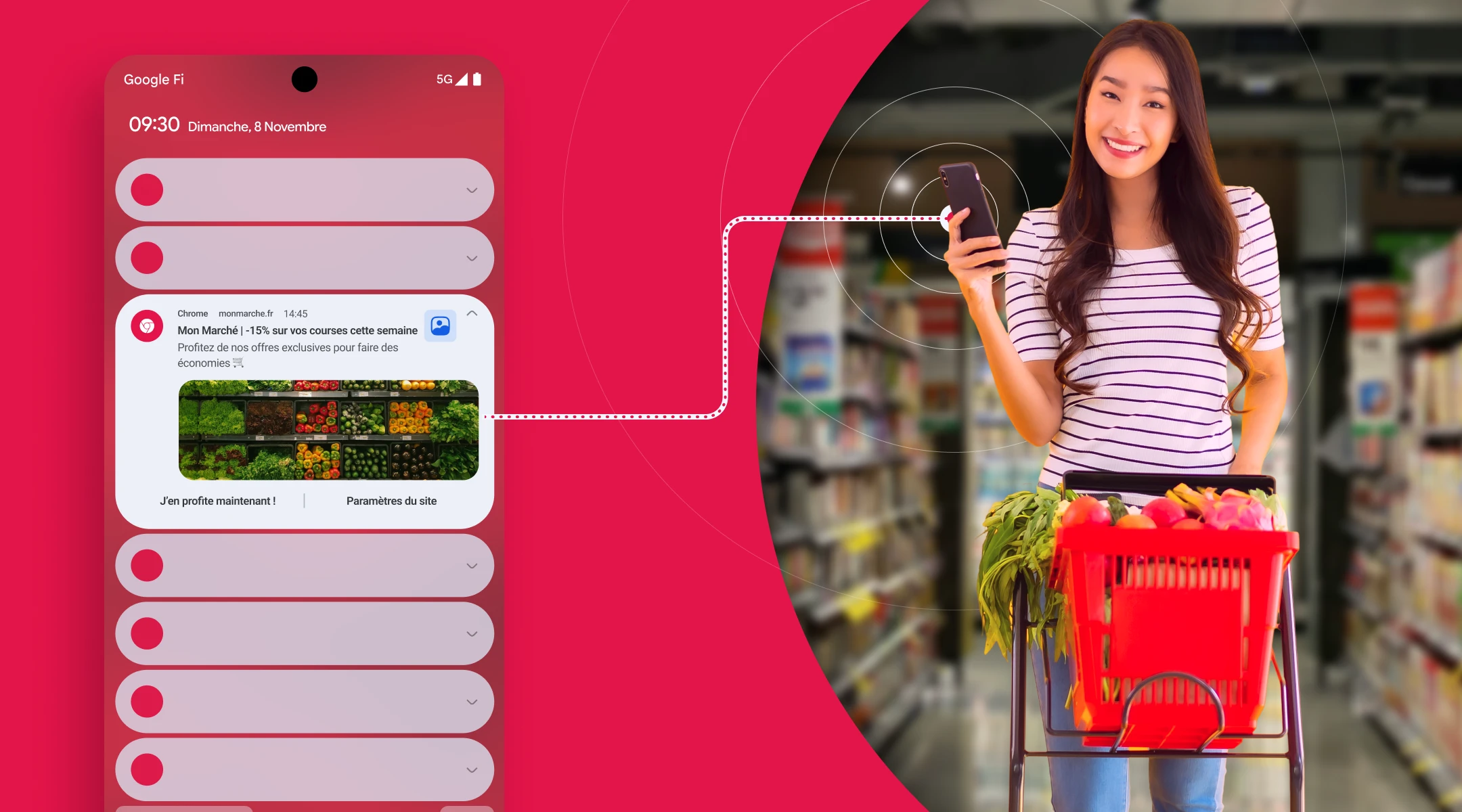
Web Push Notification is structurally suited to hyper-personalisation: triggered by behavioural events, it displays in real time and incorporates dynamic content (visuals, text, hooks). By 2030, every notification will be personalised at the individual level with no additional manual configuration. This is the natural evolution of what Dynamic Creative Optimization (DCO) applied to push messages already enables today.
A concrete example already observable in 2026: a notification sent by a retail chain offering a personalised deal based on the user’s geographic location and the stock available at the nearest store. By 2030, one can imagine going a step further, with an added layer of promotion adapted to the user’s scoring.
AI as a decision-making engine, not just execution
Artificial intelligence has been present in marketing tools for several years, mainly for execution tasks: generating email subject line variants, predicting the best send time, segmenting an audience. This is only the beginning.
The underlying trend taking shape through 2030 is the shift from AI as assistant to AI as decision-maker. In concrete terms, automation systems will themselves decide: which channel to activate for which user, which message to send, which offer to propose, at what frequency, and when to stop soliciting an unresponsive user.
What tools already do in 2026
- Churn prediction and automatic triggering of retention sequences
- Real-time behavioural lead scoring
- Individual send-time optimisation: each subscriber receives the notification at the time they are statistically most receptive
- Automatic generation of short-form content (notification titles, email subject lines, SMS text)
What will arrive by 2030
- Automated causal attribution: AI identifies which channel actually drove the conversion and reallocates budgets accordingly, with no human intervention
- Full predictive orchestration: for every user, the system decides in real time on the optimal next touchpoint across the entire stack
- Individual journey generation: teams define objectives (activation, loyalty, reactivation) and the AI builds the optimal journey per user
- Detection of weak purchase-intent signals, even in the absence of explicit on-site behaviour
Web Push occupies a special place in this setup: it’s the channel with the shortest delay between decision and receipt. When AI detects an opportunity, the notification will appear within the second.
Cross-channel orchestration: towards the single platform
In 2026, the average marketing stack for an e-commerce or media player includes between 8 and 15 tools that communicate only imperfectly with each other. Customer data is fragmented across the CRM, the ESP, the push platform, the SMS tool, paid platforms and the analytics tool. Each tool optimises within its own silo. The result: inconsistent journeys, duplicate solicitations and a necessarily partial view of the customer.
The major trend is towards consolidation. By 2030, the market will converge towards unified customer engagement platforms capable of managing all channels from a single interface, with a consolidated real-time customer view. Customer Data Platforms (CDPs) will integrate increasingly natively with activation tools.
💡 A 2030 orchestration example
A user abandons a cart. The AI orchestrates: 1 hour later, a push notification with the product and stock level. If no click, an email on day 1. If no open, an SMS on day 3. If still no response, paid retargeting for 7 days. If a conversion occurs, immediate exclusion from all follow-up sequences. Each channel plays its role with no duplication, no contradiction, no over-solicitation.
This positioning fundamentally changes Web Push’s place: it’s no longer a siloed channel, but the first piece of the overall orchestration, activated first due to its responsiveness and near-zero cost per send.
First-party data: Web Push as a natively compliant channel
The rise of personal data regulation (GDPR in Europe, CCPA in the United States, and their growing number of equivalents worldwide), combined with tightening browser privacy policies, is profoundly reshaping the foundations of digital marketing.
Cross-site tracking is eroding. Advertising identifiers are being restricted. Attribution measurement is becoming harder. For marketing teams that built their strategies on third-party data, the transition is painful. For those who planned ahead, it’s an opportunity to widen the gap.
First-party data is becoming the number one strategic asset. Brands that invested early in proprietary behavioural data collection, loyalty programmes and qualified opt-ins will have the least to rebuild.
Web Push is natively first-party
This is one of its most significant structural advantages, often underestimated. To subscribe to a site’s Web Push notifications, the user clicks “Allow” in their browser. No personal data is transmitted, no email is requested. The subscription creates a direct communication channel based on an anonymous browser identifier.
- Native GDPR compliance: consent is explicit, documented by the browser, and revocable by the user at any time
- Regulatory independence: upcoming restrictions on tracking don’t affect Web Push, which relies on no cross-site tracking mechanism
- Technological resilience: unlike cookies or advertising identifiers, the Web Push mechanism is a W3C standard, stable and cross-browser
By 2030, in an ecosystem where third-party data will be very heavily restricted, Web Push will be one of the few channels enabling direct, permissioned and measurable communication with a user, without depending on intermediaries.
Loyalty and retention automation: the full lifecycle
For a long time, marketing automation was designed almost exclusively for acquisition and conversion. Loyalty was managed manually, often with tools separate from the rest of the stack. This divide is fading. By 2030, automation platforms will cover the entire customer lifecycle on a single system, with a unified view.
The economic logic is relentless: in most sectors, reducing the churn rate by 5 points generates more value than increasing the acquisition budget by 20%. Automation tools will therefore deploy massively on these use cases.
E-commerce
Loyalty automation will rely on dynamic rewards programmes, hyper-personalised cart recovery sequences and early detection of churn signals. Web Push will be the channel of choice for loyalty status notifications, expiring points alerts and exclusive member offers.
Media and publishers
Fighting digital subscriber churn is becoming the central challenge for publishers in 2026. Our guide on how to generate traffic and revenue with Web Push explores this topic in detail. Web Push is particularly well positioned here: it’s the channel that brings the user back to the site without requiring them to open their inbox, with a significantly higher click-through rate on fresh content.
SaaS
B2B churn prevention is becoming automated. Our guide on how to reduce churn details retention strategies applicable right now. In-product behavioural signals feed risk scores that trigger automatic interventions. Web Push will find its place in engaging users outside the app session: reminders about unused features, feature announcements, webinar invitations.
Real estate
Automating the lifecycle of a buyer prospect, which can span 12 to 24 months, is still largely manual in most agencies. By 2030, platforms will make it possible to maintain an automated, personalised connection over that entire period: alerts for properties matching criteria, contextual follow-ups based on interest signals, reassurance messages at key moments in the buying process.
New surfaces: beyond the desktop browser
In 2026, Web Push works on computers (Windows, macOS, Linux) and on mobile (native Android, iOS since version 16.4). That’s already very broad coverage. But display surfaces continue to multiply, and the next four years will significantly extend the range of channels reachable by notification.
Wearables and connected TV
Smartwatches (Apple Watch, Wear OS) already receive notifications from their native apps. Extending this to Web notifications is under discussion at W3C standards level. If it materialises by 2028-2030, it will be an additional channel requiring no extra effort from publishers.
Web Push on connected TV is not yet a reality in 2026, but it is technically conceivable by 2030 on certain devices. The most obvious use case: alerts for new seasons, personalised recommendations, live notifications.
Enriched formats
The classic Web Push notification is evolving towards richer formats. Modern browsers already allow action buttons (up to two buttons in the notification), large-format images and counter badges. By 2030, standards will likely evolve towards even more interactive notifications: product carousels, mini-forms, short video content. What native mobile enables today, the Web will gradually catch up to.
Progressive Web Apps (PWA) as an acceleration vector
PWAs let websites behave like native apps, including for notifications. PWA adoption is steadily progressing, particularly in online retail and media. Every site that adopts a PWA architecture effectively widens the scope of its push capabilities, with a user experience close to native.
What these trends mean concretely for your strategy today
Anticipating 2030 doesn’t mean waiting until 2030 to act. Each trend described here has an immediate operational translation.
- On hyper-personalisation: enrich your segments with the behavioural data you already have. Dynamic personalisation of notification content is available today on Adrenalead, via DCO.
- On AI: incorporate automatic send-time optimisation into your campaigns. CTR gains of 20 to 40% on well-built bases.
- On cross-channel orchestration: audit your current sequences to identify duplicate solicitations. Define priority rules between channels.
- On first-party data: accelerate your Web Push opt-in collection programme. Every visitor who accepts notifications today gives you a direct communication channel to deploy.
- On loyalty: identify the behavioural signals that precede churn in your sector and build automated sequences triggered by those signals.
Our article on Web Push ROI details the key metrics to track to measure the impact of these actions.
Marketing automation in 2030 will be unrecognisable compared to 2020 practices
AI will decide, orchestration will be cross-channel and real-time, first-party data will be the only reliable foundation, and personalisation will happen at the individual level, not the segment level.
In this landscape, Web Push Notification occupies a rare strategic position: a direct channel, with no intermediary, natively compliant with regulatory requirements, suited to real-time communication and extensible to new surfaces. Brands that make it a pillar of their engagement strategy starting in 2026 will be best positioned to capitalise on the developments unfolding through 2030.
The competitive advantage won’t come from having the largest number of tools. It will come from having the right connections between them, the best proprietary data, and the most direct channels to your audience. On all three dimensions, Web Push ticks every box.