On 31 March 2025, Carrefour stopped delivering paper leaflets to letterboxes. The retailer had set out to digitise 100 % of its catalogues by 2026: target met a year early, with 15,000 tonnes of paper saved annually. Monoprix led the way back in 2019, Cora in January 2023, E.Leclerc in September of that same year.
In three years, a medium half a century old has all but vanished from the French landscape. The catch is that many retailers replaced the leaflet with an online catalogue, and those are not the same medium at all.
The leaflet was a push medium, the digital catalogue is a pull medium
A paper leaflet lands in the letterbox without the customer asking for anything. They see it, even absent-mindedly, and stumble on a promotion they were not looking for. It is an interruption medium, and that is precisely what built weekend footfall in hypermarkets.
A digital catalogue, by contrast, sits quietly on a website or in an app. To read it, the customer has to think of it, open the app, select their store. In other words, they must already intend to go. The medium no longer creates the visit, it accompanies it.
The consequences have been visible elsewhere in Europe. Lidl trialled dropping leaflets in the United Kingdom and Slovakia before reversing course, and several German and Dutch retailers relaunched their paper campaigns after recording a fall in footfall.
Paper was not irreplaceable, then. What was irreplaceable is its mechanic: reaching the customer without the customer having to come looking.
What Web Push restores
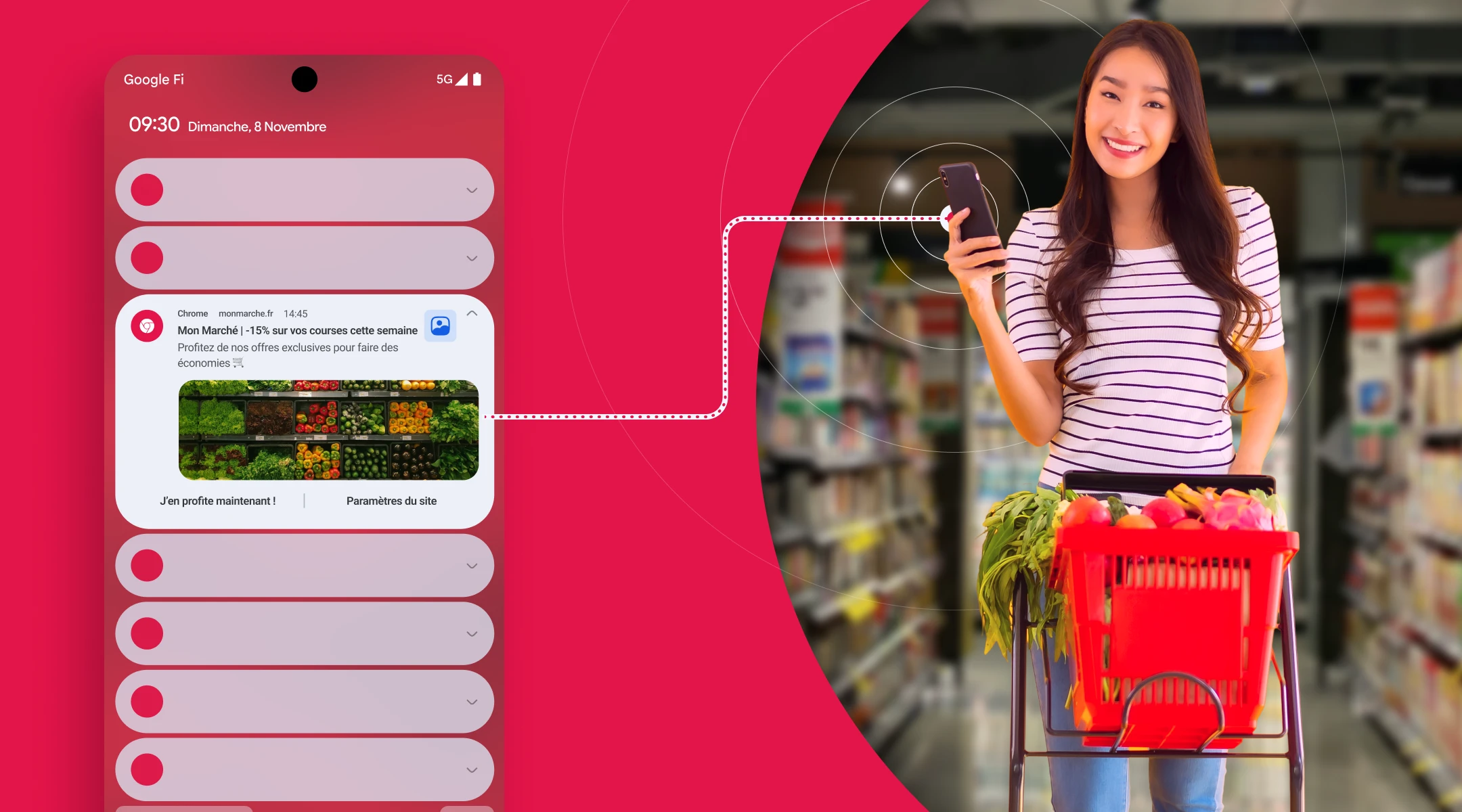
The web push notification is the only digital channel that reproduces this mechanic without asking for an email address, a phone number or an app install. A visitor to your website or store page accepts notifications in one click, and becomes reachable directly on their phone or computer screen, including when they are no longer browsing your site.
In practice, your Thursday promotion reaches them the same way a leaflet reached their letterbox: with no effort on their part. The difference is that you know who received it, who clicked, and at what time. How the format works in detail is set out on our Web Push page.
How it works for a retailer with a physical network
The logic differs from a pure-play e-commerce operation on three points, and that is where most programmes are won or lost.
Collection happens store by store
A subscriber is only useful if they are tied to a point of sale. Collection is therefore triggered on store pages, local catalogue pages, or after a nearest-store search. The retailer builds not one national base, but as many bases as it has catchment areas.
Geographic targeting replaces the delivery round
Where the leaflet was distributed across a sector defined in advance, the notification is targeted by area, which allows delivery to be aligned exactly with the real catchment area. A city-centre store and an out-of-town hypermarket six kilometres apart can send different messages on the same day.
The message becomes contextual
A leaflet is printed three weeks ahead. A notification goes out the same morning. That opens up uses impossible on paper: clearing surplus fresh produce, reacting to the weather, extending an operation that is working, promoting a seasonal arrival. It is the same personalisation logic as a dynamic display advertising banner, but on a channel that does not need an available ad slot to exist.
The campaigns that actually work
- The weekly catalogue, pushed on Wednesday or Thursday evening, with a direct link to the nearest store’s offers
- The limited-time offer on fresh produce at the end of the day, restricted to subscribers in the immediate vicinity
- The commercial event reminder: wine fair, back to school, anniversary event
- The restock alert on a high-demand product, targeted at customers who viewed it online
- Loyalty programme activation: expiring points, coupon to redeem at the till
- Click and collect: slot reminder, item left in the basket
To go further on the scenarios, our playbook of 12 drive-to-store campaigns sets out templates ready to adapt.
Measuring in-store impact, without kidding yourself
This is the leaflet’s historic weakness: nobody ever really knew what it returned. Digital only improves matters if you agree to measure properly.
Click-through rate is not enough, because a click on a notification is not a store visit. Three approaches give an honest reading: couponing with a campaign-specific code scanned at the till; click-and-collect tracking where the journey is digitised end to end; and above all incrementality testing, which means deliberately excluding some subscribers in an area to compare footfall against a control group.
That last method is the only one that answers the real question: how many visits did the campaign create, compared with those that would have happened anyway.
The mistakes that cost dearly
The first is treating the base as a national mailing list. Sending the same promotion to the whole country reproduces the leaflet’s flaw without keeping its advantages.
The second is over-messaging. Unsubscribing is immediate and permanent, in one click, with no way back. One or two notifications a week is a sustainable rhythm for an active base; beyond that, the base melts away.
The third, more insidious, is pushing nothing but promotions. A base that only ever receives discounts loses perceived value. Alternating with useful information, such as exceptional opening hours or the arrival of a local producer, sustains interest between peak moments.
What to take away
The disappearance of the paper leaflet was not a loss of medium, it was a loss of mechanic. Retailers that simply moved their catalogue online swapped a channel that went out to fetch the customer for a channel that waits for them.
Web Push restores that balance, with what paper could never offer: targeting down to the catchment area, day-to-day responsiveness, and at last a measurable read on the footfall generated.
Frequently asked questions
How do you replace paper leaflets with push notifications?
The web notification reproduces the mechanic that made the leaflet powerful: it reaches the customer without them having to look for it. The weekly catalogue is pushed to the screens of subscribers tied to a store, with a direct link to local offers. Subscribers are collected on the site’s store pages, in one click, with no email address or app to install.
Web push notifications for physical retailers: how does it work?
A visitor accepts notifications from their browser by clicking an invitation. They are then tied to a point of sale and a geographic area. The retailer can then send them messages targeted by store, even when they are no longer browsing the site. No personal data is collected and no app is required.
Can you target only customers near a store?
Yes. Targeting is done by geographic area, which allows delivery to be aligned with each outlet’s real catchment area. Two stores a few kilometres apart can therefore run different offers on the same day, unlike the leaflet whose delivery round was fixed.
How do you measure the drive-to-store effect of a push campaign?
Click-through rate is not enough, because a click is not a visit. Three methods give a reliable reading: a campaign-specific promo code scanned at the till, click-and-collect tracking, and incrementality testing, which compares footfall in an exposed area against an unexposed control group.
Do you need a mobile app to send push notifications?
No. Web Push works directly from the browser, on mobile as well as desktop. That is what sets it apart from app notifications: no download is asked of the customer, which removes the main obstacle to building a subscriber base for a physical retailer.