🕒 Updated on
In 2026, the race for customer acquisition is more intense than ever. In a hyper-competitive landscape, every lead or conversion is earned through strategic effort across multiple channels. B2B marketers, e-retailers, and publishers must adapt their approaches and goals to new trends: longer customer journeys, more touchpoints, rising ad costs, and pressure for immediate profitability. At the same time, technological (AI, automation) and regulatory shifts are reshuffling the deck of digital acquisition. The result: an effective company acquisition strategy in 2026 relies on omnichannel orchestration, personalization, and rigorous performance measurement.
According to a recent study, 70% of companies see better results with a multichannel strategy. What’s more, despite an uncertain economic climate, 44% of companies increased their digital ad budgets in 2025—clear proof that digital marketing is seen as vital. In this guide, we’ll review how acquisition strategies have evolved, then analyze the main digital levers (SEO, SEA, email, social media, influence, affiliation, B2B partnerships, events).
We’ll highlight the omnichannel complementarity of these levers before zooming in on our channel of choice: Web Push!
- Defining an acquisition strategy
- 2026 trends: how digital acquisition is evolving
- What are the main channels of a solid acquisition strategy?
- SEO: the foundation of sustainable visibility
- SEA: search advertising (Google Ads & more)
- SEO vs SEA: a winning, complementary duo
- Email: the undefeated B2B king?
- Social media: community, engagement, and ad targeting
- Influencer marketing: authenticity that converts
- Affiliate marketing: pure performance to extend your reach
- B2B partnerships: strategic alliances & co-marketing
- Events: the return of human, direct contact (in-person & digital)
- Omnichannel orchestration and lever complementarity
- Focus: is Web Push the new queen of your acquisition strategy?
- Acquisition is won through synergy, value, and agility
- Enhance my acquisition strategy with Web Push!
- What are the best acquisition strategies?
- How do you measure the effectiveness of an acquisition strategy for a company?
- Which online channels are most effective for customer acquisition?
Defining an acquisition strategy
An acquisition strategy is the set of actions a company puts in place to attract new customers or users to its products, services, or content. Its goal is to generate qualified traffic, capture the attention of a target audience, and convert that audience into leads or buyers.
It can activate different levers such as:
- Search Engine Optimization (SEO)
- Paid advertising (SEA, social ads, display)
- Content marketing
- Social media
- Email marketing
- Web Push
A solid acquisition strategy is multichannel by design and relies on deep audience understanding, performance measurement, and continuous conversion-funnel optimization.
2026 trends: how digital acquisition is evolving
Acquisition strategy has been evolving rapidly for several years. Today, your prospects and visitors move through many channels before purchasing: website, social media, email, events… You need to be present everywhere to capture attention at the right moment.
To drive deeper engagement, you must bet on personalization. With artificial intelligence, you can tailor messages to each profile. That makes campaigns more effective.
But technology is not enough—you must build trust! Consumers and professionals prefer useful content, genuine customer testimonials, and authentic recommendations over traditional ads. That’s why brands are investing more in quality content and social proof.
Another major shift: the end of third-party cookies is pushing businesses to rely on their own databases (emails, subscribers, members…). These are first-party data—more reliable and privacy-friendly.
Finally, everything must be measured. Budgets are scrutinized, and each campaign must prove its return on investment. Businesses prioritize channels that deliver fast, measurable results, such as SEA, retargeting, or affiliate marketing.
💡 Adrena’tips: balance short-term vs long-term investment. Studies (Binet & Field) often recommend a 60% brand / 40% performance mix to blend durable awareness with immediate conversions. Applying this ratio (e.g., on €10,000: €6,000 to brand campaigns and €4,000 to performance), you build a strong brand while generating short-term, measurable results.
What are the main channels of a solid acquisition strategy?
Modern marketers have a broad palette of levers to reach and convert their audiences. Each channel has its strengths, weaknesses, costs, and typical ROI. The challenge is to choose the right levers for your target (B2B vs B2C), objectives (traffic, leads, sales), and budget—then activate them coherently.
Here’s a quick overview of the main digital channels, with each one’s role, best practices, and pitfalls to avoid.
SEO: the foundation of sustainable visibility
SEO (Search Engine Optimization) remains a central pillar of acquisition in 2026. It’s the art of optimizing your site and content to appear at the top of organic results on Google (and other engines). Its major advantage: attracting qualified traffic “for free” (no cost per click) with lasting impact. 61% of marketers consider SEO their #1 lead-acquisition strategy. In B2B, SEO even generates more sales than Pay-Per-Click (PPC) for 70% of surveyed marketers—proof of its profitability.
However, SEO requires time and ongoing effort: it often takes months to rank on competitive keywords. In 2026, SEO is more complex due to algorithm updates (UX signals, Core Web Vitals, E-E-A-T content…) and the rise of AI-assisted content. To win, you must double down on expertise and publish the best content possible on your topic.
SEO best practices in 2026:
- Target intent and long-tail queries: don’t focus only on a few generic keywords. Identify the specific queries of your audience (e.g., “CRM software for industrial SMBs” rather than “CRM software”). 75% of marketers deem long-tail keywords essential to SEO success because they capture qualified, less competitive traffic.
- Optimize user experience (UX): Google rewards sites that are fast, mobile-friendly, and easy to navigate. In 2025, 64% of Google searches were on mobile, so a responsive, lightweight site is a must. Better UX also improves conversion from SEO traffic.
- Publish expert, fresh content: prioritize quality over quantity. Deliver educational pieces (guides, studies, infographics) that answer your prospects’ questions. Regularly update strategic pages. A value-driven blog (not thin “SEO filler”) also earns natural backlinks that boost authority.
- Build site authority (E-E-A-T): earn backlinks from credible, sector-relevant sites; showcase certifications, customer reviews, and case studies. Anything that proves your expertise and reliability to Google (and users) will lift your rankings.
💡 Adrena’tips: SEO is useless without conversion behind it. Make sure your SEO landing pages are persuasive and well designed. An organic visitor must instantly grasp your value proposition. Place a visible above-the-fold CTA, simplify forms, and reassure with proof (reviews, client logos). Every friction point removed increases the ROI of your SEO investment.
SEA: search advertising (Google Ads & more)
SEA (Search Engine Advertising) is paid ad distribution on search engines—especially Google, which dominates queries. It’s the world of PPC and keyword bidding. Its big strength: delivering ultra-targeted traffic immediately. You choose keywords tied to your offer, and your ads appear at the top when people search those terms. In B2B and e-commerce, Google Ads is often indispensable to capture prospects in the active solution-seeking phase.
In 2024, global search-ad spend reached $281 billion—underscoring this lever’s importance. In 2025, SEA stayed effective but faced headwinds: higher CPCs due to fierce competition, gradually weaker targeting efficacy (farewell third-party cookies, more tracking limits), and the need for continuous optimization to maintain positive ROAS.
SEA best practices:
- Choose keywords and match types wisely: focus budget on the most relevant queries (explicit commercial intent). Use exact match for strategic terms and negatives to exclude off-target searches. In B2B, target, for example, queries like “X software for enterprises” or “Y supplier B2B” to capture qualified prospects.
- Improve Quality Score and relevance: Google rewards well-configured, relevant ads (lower CPC). Align the trio searched keyword / ad copy / landing page. A high Quality Score boosts position and reduces cost. Create dedicated landing pages per key ad group to provide the most aligned content for the user’s query.
- Leverage all ad extensions: sitelinks, callouts, structured snippets, lead-form extensions, etc. take up more SERP real estate and increase CTR. In 2025, top campaigns used extensions systematically to maximize visibility and provide useful info (e.g., reviews, phone, location).
- Measure and optimize continuously: SEA is not “set & forget.” Monitor KPIs daily (CPC, CTR, conversion rate, CPA, ROAS). Pause or rework underperforming ads/keywords and reallocate budget to winners. Regularly test new messaging, offers, or audiences (for the Display network). Crucially, tune bidding strategy: if a keyword converts with a ROAS of 5, increase bids/budget to scale it. Conversely, lower bids on expensive, non-converting terms.
💡 Adrena’tips: don’t burn your budget on day one. Test small before you scale. For example, invest 10–20% of your budget over 2–3 weeks to test different channels or campaigns, then double down on those with the lowest CPA or best ROAS. This “pilot” approach avoids heavy losses and increases your odds of finding the winning mix.
SEO vs SEA: a winning, complementary duo
SEO and SEA (search advertising) are often pitted against each other, but they’re actually complementary. Here’s a comparison table that sums up the differences:
| Criteria | SEO (organic search) | SEA (sponsored links / PPC) |
|---|---|---|
| Cost per click | Free (no direct CPC, aside from internal resources). | Paid (CPC bidding on target keywords). |
| Time to results | Long term (months to rank; patient investment). | Immediate (visibility as soon as the campaign launches). |
| Duration of effects | Durable (ongoing traffic once ranked; persistent effect). | Short-lived (traffic drops as soon as budget is cut). |
| Average click-through rate | High: organic results capture ~90–94% of clicks. | Lower: ~6–10% of clicks go to ads. |
| User trust | Strong (perceived as “earned”; higher credibility). | Lower (ad label; part of users are wary). |
| Best use case | Long-term visibility & credibility; ongoing acquisition at lower CPL. | Short-term actions: product launches, flash promos, offer testing, high-intent commercial queries for quick conversions. |
SEO excels in long-term profitability and credibility, while SEA shines through speed and targeting. A strong 2026 strategy combines both—for example, using SEA to immediately appear on critical keywords (while SEO ramps up), or to test conversion on queries before investing in SEO content.
Also, SEA data (converting keywords, effective ad copy) can feed your SEO strategy—and vice-versa.
Email: the undefeated B2B king?
Year after year, email marketing remains one of the most effective acquisition and retention channels, especially in B2B. In 2026, despite the boom in new channels, email still delivers outstanding ROI: on average €36 generated for every €1 invested. 64% of marketers say email is their most effective lead-acquisition channel—a telling figure!
Email’s advantages are many: low costs (sending 10,000 emails costs a fraction of any other paid campaign), broad reach (virtually every professional uses email daily), and flexibility (highly personalized content, rich media, etc.). It’s an ownership channel: you own your contact base, without an algorithm in between. In B2B, it excels at long-term nurturing (newsletters, content shares, webinar invitations…), targeted cold outreach, and of course commercial follow-ups.
That said, email in 2026 requires finesse and strategy. Inboxes are crowded: professionals receive dozens of messages daily, some unwanted. You need to stand out and avoid the spam bin.
Keys to perform:
- Granular segmentation: no more “one-size-fits-all” blasts. Segment by profile, industry, buying-stage, declared interests, etc.
- Personalization & crafted subject lines: a personalized email (recipient name, company reference, a recent action) drives higher opens and clicks. Never neglect the subject line: 33% of recipients open an email based on it.
- Smart automation: build workflows to increase timeliness and relevance. Examples: instant welcome email after signup; nurturing sequences triggered by actions (whitepaper download, visit to a product page); abandoned cart series for e-commerce.
- Content & timing optimization: keep emails clear, airy, and action-oriented. Each message should center on one goal (not 10 offers in one mail).
- List hygiene & deliverability: keep the list clean (remove/quarantine inactive addresses) to improve deliverability.
💡 Adrena’tips: in B2B, a well-executed email can be a game changer. For instance, the average open rate of cold B2B emails hovers around 36%, which is significant compared with engagement rates on other channels. Invest time in your cold-email campaigns.
Social media: community, engagement, and ad targeting
By 2026, being active on social platforms is a given. The real question is how to invest wisely—and how to stand out. For e-retailers and B2B pros alike, social plays a dual role: build an engaged community and precisely target prospects via paid ads.
In B2B, LinkedIn remains the gold standard—the place where decision-makers get informed, discuss, and let themselves be influenced. It’s estimated that 80% of B2B leads from social come from LinkedIn. In B2C, Facebook and Instagram still dominate, but TikTok is gaining ground, especially among younger audiences and for authentic/viral content. Other platforms also have their place depending on use cases: X for tech news and monitoring; Pinterest for visual niches (fashion, decor, food); and YouTube—both a social network and search engine—indispensable for video marketing.
In numbers:
- 80% of B2B buyers check social media before a purchase decision
- 46% of marketers say social delivers the best ROI in their campaigns
Ignoring social means missing a strategic showcase. Conversely, an active presence reassures, demonstrates expertise, and fuels social proof.
Influencer marketing: authenticity that converts
Long confined to B2C fields like fashion, beauty, or travel, influencer marketing has matured. Today it’s highly relevant in B2B and specialized e-commerce. Partnering with a creator builds credibility and reaches a targeted, already-engaged audience. At a time when consumers and decision-makers distrust overly commercial messaging, influence offers a more human—and often more effective—channel.
Keys to successful influencer campaigns
Choose the right profiles
No need to chase celebrities. It’s better to collaborate with niche voices who speak to your audience. In B2B, that could be a respected LinkedIn or YouTube expert; in e-commerce, a creator in your vertical (tech, sports, eco-friendly…). What matters is alignment between your product and their audience—and genuine engagement.
Allow creative freedom
The most effective partnerships are those where the creator keeps their voice. They know how to talk to their community. A sincere, first-person testimonial (“here’s how I use this product”) beats a scripted message. Authenticity drives credibility—while respecting disclosures (“partnership” or “collaboration”).
Diversify formats
Influence isn’t limited to Instagram. Depending on your sector, consider sponsored LinkedIn posts, X threads, a guest article, a TikTok video—or even a co-hosted podcast or webinar. In 2026, short video still rules attention, but long-form content performs well for qualified B2B lead gen.
Measure outcomes
Track performance precisely to judge profitability: number of promo-code uses, clicks on tracked links, downloads of a guide from a dedicated landing page…
Build long-term partnerships
Rather than one-offs, aim for long-term relationships. A creator who mentions you regularly becomes a credible ambassador to their audience. That strengthens trust and helps you build a coherent brand image over time.
Affiliate marketing: pure performance to extend your reach
Far from outdated, affiliate marketing remains a strong lever for controlled, performance-based acquisition. The principle is simple: you entrust promotion to external partners (comparison sites, bloggers, media, creators…), who are paid commissions on the sales or leads they generate.
It’s win-win: no results, no cost. Ideal for B2C e-retailers via cashback/deal sites, and also for B2B via referral and reseller partnerships.
Key benefits are clear:
- Controlled costs—pay for performance
- Extended reach thanks to affiliates’ visibility
- Scalability—the more active partners you have, the wider your reach
Watch the risks: protect your brand image, avoid shady practices, and don’t underestimate the time needed to manage the network.
B2B partnerships: strategic alliances & co-marketing
In both B2B and B2C, partnerships are a powerful way to pool acquisition efforts while reducing costs. The idea: collaborate with a complementary player to cross-pollinate audiences, credibility—and results.
Formats vary:
- Co-created content (whitepaper, webinar, joint blog article)
- Bundled offers or cross-promotions
- Inter-company referral programs
- Product integrations (offer a partner trial to your customers)
💡 Concrete example: a payments solution and an e-commerce platform co-host a webinar on conversion optimization. Both invite their lists and share the leads—delivering visibility, authority, and immediate ROI.
Events: the return of human, direct contact (in-person & digital)
In 2026, events remain essential—especially in B2B. Trade shows, conferences, and webinars create direct connections with prospects, generate qualified leads, and strengthen brand credibility. In-person is back in force, while digital formats—more accessible—still matter. The trend is hybrid: blend physical visibility with online reach.
To be effective, treat an event like a full acquisition campaign: pre-event communications, contact capture during the event, and rigorous follow-up afterwards. Post-event work (follow-ups, supporting content, nurturing) is what maximizes conversions.
ROI can be measured with simple indicators: number of leads captured, conversion rate, cost per lead. While sometimes pricier than other channels, event leads are often more engaged.
Finally, the content generated (replays, photos, summaries) extends visibility and fuels your other channels.
Omnichannel orchestration and lever complementarity
In 2026, acquisition no longer happens on a single channel. Strength lies in a well-orchestrated omnichannel strategy, where every touchpoint—site, email, social, ads, events, etc.—fits into a coherent, fluid journey for the prospect.
Tips to be effective:
- Ensure consistent messaging and visual identity across all sales touchpoints.
- Centralize data in a CRM or CDP to get a clear view of the prospect journey.
- Map channels to the buying cycle: SEO to attract, ads to retarget, email to convert, events or calls to close.
- Track cross-channel performance with multi-touch attribution to spot winning combinations.
Finally, digital and physical are not opposites. A “phygital” approach—combining both—amplifies impact and trust.
Here’s a recap comparing strengths and weaknesses of traditional vs digital channels and tools:
| Aspect | Traditional channels (TV, radio, print, trade shows…) | Digital channels (web, search, social, email…) |
|---|---|---|
| Reach & audience | Very broad (e.g., national TV) or locally targeted (OOH). Ideal for mass awareness. | Precise targeting (interest, intent, demographics), potentially global reach—but fragmented audiences. |
| Entry cost | Often high: production + media buying. Significant ticket (e.g., >€5,000 for local TV). | Flexible and modular budgets; start small. Performance buying (CPC/CPA) to control acquisition cost. |
| Performance measurement | Indirect: estimated audiences and recall; weak link to conversions. Hard short-term ROI. | Granular, real-time measurement: clicks, conversions, cost per action, attribution, A/B testing, continuous optimization. |
| Interaction & engagement | One-way: passive broadcast; little instant interaction. Slow feedback (post-campaign studies). | Interactive: the user clicks, comments, shares. Near-instant dialogue (social, chat, site). |
| Personalization | Low: same creative for all. Segmentation mostly by channel/title. | Very high: personalized, behavior-based messages (email, retargeting, automation). |
| Perceived credibility | High thanks to established media (signals “serious brand”). Strong brand-image impact. | Variable: content/ad overload. Social proof and expertise rebuild trust (reviews, creators, media). |
In practice, a smart mix of both often wins. For example, a TV/radio campaign creates broad awareness that is later captured and converted via digital (brand name search, site visits, etc.). Conversely, digital data can guide local OOH (target cities where e-commerce sales are strongest). Some B2B brands run VIP events to close deals initiated via social selling… The combinations are endless—always think in terms of the customer’s end-to-end journey.
💡 Adrena’tips: think unified customer experience. A prospect who sees a LinkedIn ad and then receives your email expects continuity. If they engaged with offer X, don’t send another email about offer Y with no connection. Segment and orchestrate: “Mr. Dupont” engaged on topic A, so he receives relevant follow-ups on that topic. CRM and marketing-automation tools make this possible.
Focus: is Web Push the new queen of your acquisition strategy?
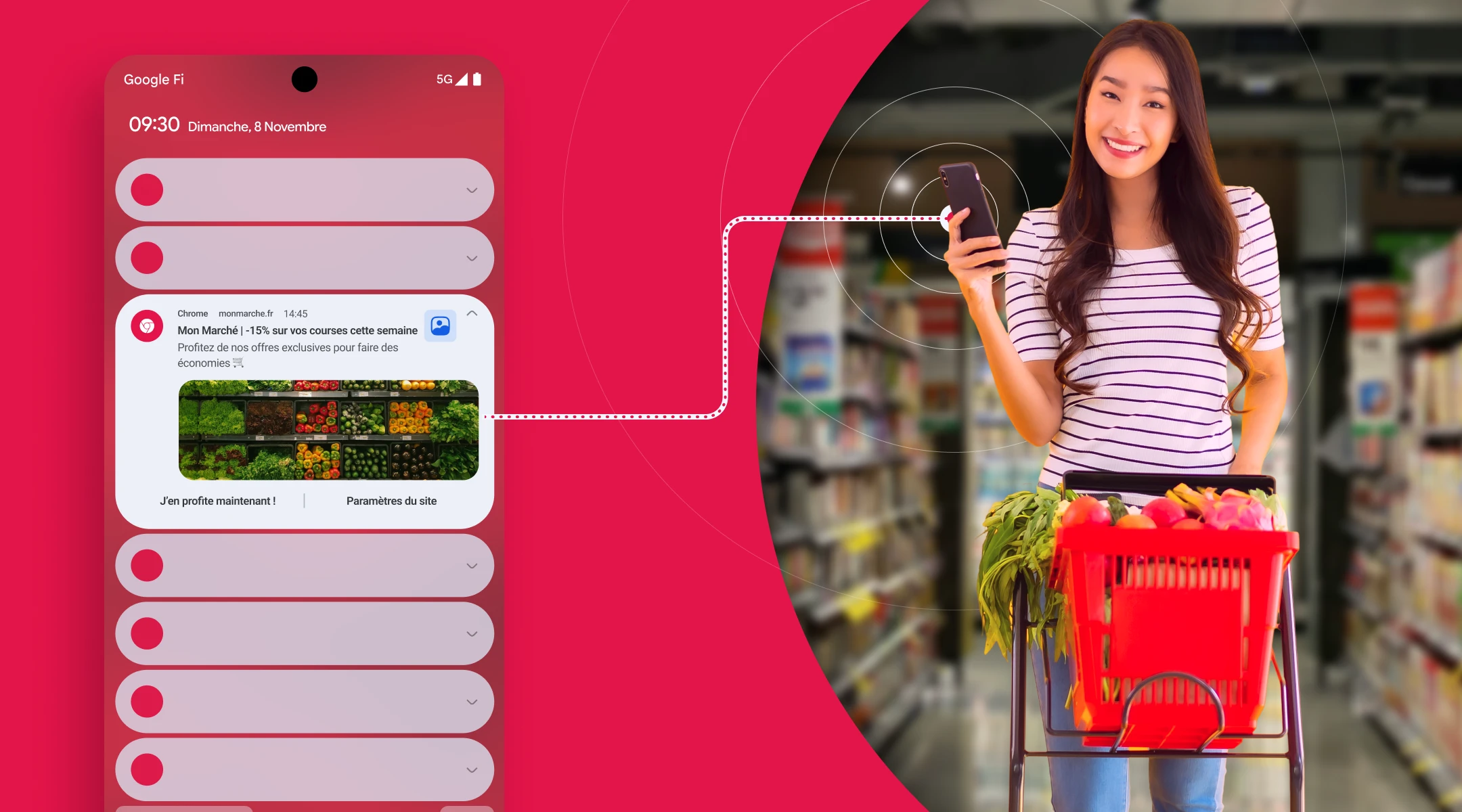
Now essential to your conversion funnel, Web Push stands out as a simple, powerful, GDPR-compliant tool. It lets you send clickable messages via the browser (Chrome, Firefox, etc.) even when users aren’t on your site and without asking for their email.
Why adopt Web Push?
- Immediate visibility: messages appear directly on screen, often with higher CTR than email.
- No personal data: the user simply consents via their browser. No email or third-party cookies needed.
- Automatable & scenario-ready: welcomes, cart recovery, flash promos… Web Push supports the whole buying cycle.
- “Off-site” acquisition: with networks like Adrenalead, you can reach opt-in users across thousands of sites—akin to Display—while bypassing ad blockers and brand-safety issues.
Acquisition is won through synergy, value, and agility
Digital acquisition has never been richer—or more demanding. In 2026, success doesn’t come from a single channel but from a well-orchestrated strategy that smartly combines valuable content, personalized experiences, and trusted relationships.
To perform, brands should focus on:
- Experience: test, optimize, improve.
- Expertise: master each lever.
- Authority: build a solid, reliable image.
- Trust: respect data and keep your promises.
No one-size-fits-all recipe: each company must find its ideal mix. For some, that’s SEO + LinkedIn Ads + webinars. For others, social retargeting + push + influence. What matters is being coherent, agile, and value-driven.
Innovations like Web Push and generative AI open new horizons: real-time personalization, ultra-targeted campaigns, lower acquisition costs… provided you integrate them intelligently into your overall strategy.
In short: be strategic, creative, and always tuned to your prospects. That’s how you’ll stand out today—and tomorrow.
Measure, learn, and today’s efforts will turn into tomorrow’s success!
What are the best acquisition strategies?
Bet on an omnichannel mix combining SEO, Web Push, events, and partnerships. Objective: boost your business and sales by working both awareness (top of funnel) and conversion (bottom of funnel). Complement with expert content and personalized offers by segment.
How do you measure the effectiveness of an acquisition strategy for a company?
Track CAC, conversion rate, ROI, and LTV. Analyze by channel and segment, use UTMs, compare exposed vs non-exposed (incremental lift), and adjust budgets/measurement continuously.
Which online channels are most effective for customer acquisition?
Depending on your business model, in 2026 the top performers remain: content & organic search, Web Push campaigns, social ads, and partner/influencer sales. Effectiveness depends on your offer, targeting, creative, and frequency.